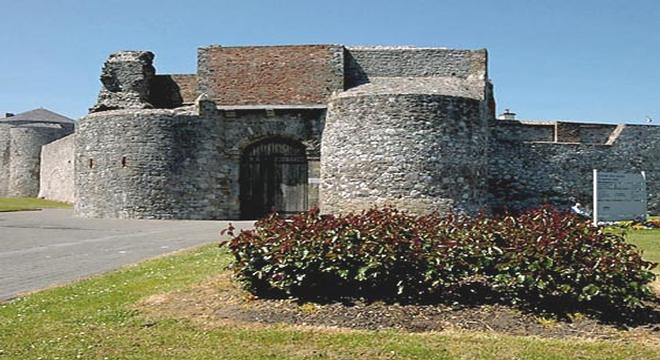
Domnall Mór’s enemies amongst the Gael and the Gall

O’Brien dynasties of Limerick as Domnall Mór came to power

As Domnall Mór came to power, the city of Limerick was surrounded by different O’Brien and Dál Cais groups. Domnall himself was a member of the Uí Thairdelbaig, the ruling dynasty which not only produced Brian Boru but also his most powerful successor, Muirchertach, the Irish high-king who gave Cashel to the Church in 1101. As discussed in a previous post, the territory of this dynasty included their dynastic base at Killaloe and the lands immediately to the east of that town but they stretched down into the area around Castleconnell, where Domnall Mór had his own hall [a thech féin] in 1175. [Castleconnell is marked with a yellow cross on the map above.]

The annals make it clear that these various groups, as well as rival candidates amongst the Uí Thairdelbaig were all jockeying for position as Domnall‘s father began to lose his grip on power in the later 1150s. When choosing a king, the medieval Irish did not follow the system of primogeniture but instead opted for those showing leadership qualities or febas. The list of necessary attributes, as with politicians today, could range from bellicosity to shrewd negotiating ability, depending on the circumstances in which the kingdom found itself. A perennial favourite (again, similar to today) were good looks while another was a close relationship to the preceding king.

In a world where men tended to marry for strategic reasons and where temporary partnerships (in addition to one’s lawfully wedded spouse) were socially acceptable, this did little to minimise the potential group of those who were rígdomna or capable of being made king. Provided the king recognised the child, all his offspring were deemed royal although there were clearly question marks about female claims on occasion; there are stories of saints helping the unborn to point out an infant’s less prestigious father at public assemblies. Brothers of the preceding king, who could often be much younger than their sibling, were also very much in the mix as Bart Jaski has made clear.  Violent infighting amongst rival candidates, particularly as a king grew old or sick, was commonplace.

One of the carved twelfth-century heads from the recently restored Cormac’s Chapel, Cashel

Domnall Mór was a grandson of Diarmait Ua Briain, ruler of Waterford and brother of the late eleventh/ early twelfth-century high-king, Muirchertach. It was not Domnall’s father but another of Diarmait’s sons, Conchobar Slapar Salach “Dirty Bandage”, who seems initially to have been the strongest O’Brien leader within his generation. Conchobar is identified as king of Munster in an entry for 1130 when he said to have captured a thief who stole jewels from Clonmacnoise. The thief was hung at Cluain Briain, in the parish of Athlacca which the later O’Brien genealogies identify as part of the holdings of Conchobar in south county Limerick and north Cork. Immediately after the death of Domnall’s father, Toirdelbach, in 1167, a grandson belonging to this south Limerick branch of the family was involved in the jockeying for inheritance of the O’Brien leadership:

“Muirchertach[of Dún na Sgiath – Fort of the Shields] son of Tairdelbach Ua Briain, was slain by Conchobar grandson of Conchobar [Slapar Salach] and that same Conchobar was slain on the third day after that by Ua Faeláin. And much slaughter was inflicted by the men of Thomond on one another.”

Other annalsadd the details that this Muirchertach of Donaskeagh, Co. Tipperary was also identified, at least by some, as king of Dál Cais and as lord of Thomond. He was a step-brother, through his mother, of the contemporary king of Connacht and one annalist states that the Waterford Ua Faeláin (or Whelan) lord, who killed Conchobar, did it on the Connacht ruler’s behalf. (One of the features of the internecine wars between dynastic rivals was the search for powerful patrons who could support them in their ambitions and it seems that in the case of Muirchertach, this was the O’Connor ruler of Connacht.) Another annalist, located far away at Armagh, claimed, in contrast, it was not Connacht but the MacCarthys of south Munster who were involved. The discrepancy may be simply due to difficulties in acquiring accurate information or it may represent different people each apportioning blame where it suited them best. It is rare, after all, for political analysts to always agree in any era!

In the year before his murder, in 1167, Muirchertach had accompanied the Connacht king on a successful military expedition involving twenty battalions of foot soldiers and cavalry going north to Tyrone, together with a fleet from Donegal. On returning to the royal Connacht base in Tuam, the high-king gave Muirchertach his father’s drinking horn as tuarastal – the word used for gifts given by superiors to their juniors to reward loyalty. The Connacht king is then said to have ridden with the MacCarthy ruler leader south to Knockainey (but no mention is made of O’ Briens in this pro- MacCarthy source). Perhaps Mac Carthaigh dropped poison in the high-king’s ear about his north Munster rival or perhaps it was the death of Muirchertach’s father in the interim which changed the political imperatives but for whatever reason, the alliance between Thomond and Connacht apparently broke apart within the year to the point that locals believed that Ruaidrí of Connacht was fostering civil war amongst the Thomond leaders.

Portrait of a king from the Cistercian abbey of Knockmoy, Co. Galway founded by Ruaidrí’s grandson and king of Connacht, Cathal Crobderg. Photo taken from Monastic Ireland Facebook page.

Whoever or whatever brought it about, the elimination of two strong rivals left the way open for Domnall to emerge from the pack of potential candidates. There was one remaining enemy, Brian of Slieve Bloom, the man who controlled the relatively new Dál Cais colony kingdom of Ormond (see preceding post). Domnall had him taken prisoner and blinded. Again, the Connacht king Ruaidrí may have played a role in this; the Annals of the Four Masters state that in the same year, Ruaidrí and his ally, Tigernán Ó Ruairc of Breifne (modern Cavan/Leitrim), brought their troops south to Knockainey, took hostages and divided Munster between the MacCarthys in Cork and Domnall Mór in Limerick. [This division of Munster had been a consistent policy of the O’Connor kings for at least two generations]. 720 cows were given to Ruaidrí by the southern lords on this occasion as a fine for having murdered Muirchertach. (Just how murky this all was depends on one’s tolerance for conspiracy; it is not particularly hard to imagine Ruaidrí having both connived at the death of the Thomond ruler and then subsequently acting the outraged overlord and punishing the murderers.) This is the second Knockainey reference in the space of two years – as the home of important O’Brien churchmen (the Uí Enna) while also being a traditional base for MacCarthy ancestors, it may well have been seen as a key location for judicial and other assemblies in this era. Again, however, the sources are not entirely consistent – the Armagh annalist states that the assembly took place at Pallasgreen held by the O’Brien lords of Coonagh.

This last was an O’Brien dynasty which was not recorded in the later twelfth century annals but it is impossible to believe that they did not form part of the contemporary political scene. These were the descendants of Donnchad, son of Brian Boru, who had retained his position as leader and king of Thomond for almost fifty years until his death in 1064 and who is recorded, in his more successful phases, as both king of Munster and high-king of Ireland. Donnchad’s son Murchad was active in the 1050s and 60s until his death in Longford in 1068 and his grandson, Brian of Glenmire is documented in the early twelfth century. It is said in fourteenth-century genealogies that Brian took his name from a battle at Glenmire in 1127/28. These same genealogies finish with two sons of Brian, Cennétig and Donnchad and later, early modern, additions state that these men were associated with Uí Briain lordships in Coonagh and Aherlow respectively. Brian Hodkinson has identified 13th C O’Briens active in Aherlow which tends to confirm the existence of these families at an earlier period than the late date of the genealogies might suggest. 

Of course, Domnall Mór’s enemies were not limited to his local dynastic rivals. At the time that he was coming to power, the scene was being set for the Norman invasion and the year of his accession, 1168, was just before the fleet of Robert Fitzstephen arrived in Bannow Bay in May 1169 with a small army of knights and foot soldiers. Fitzstephen had met Diarmait mac Murrough while the latter was in exile at the court of the king of south Wales, Rhys ap Gruffydd and fighting for the possibility of control of Wexford and surrounding territory was a more pleasing prospect than joining Rhys in fighting the Angevin king, Henry II. The successes of Fitzstephen’s men, both in conquering Wexford town and defeating the men of Ossory prompted the Connacht king into action. In the words of the Norman writer, Giraldus:

“Sending emissaries in all directions, he quickly called together the principal men of the whole island. When they had consulted with each other, they immediately and with one accord took up arms against Diarmait and gathered many armies and an infinite number of men to attack the part of Leinster called Ui Chennselaig.”  

Where did this leave Domnall who seems to have been no friend to the ruling dynasty of Connacht?  The Annals of the Four Masters suggest he was not involved and that this great host was, in fact, essentially a midlands affair, involving men from the broad belt of lands stretching from north Galway across to Cavan and down to Westmeath. Domnall’s unwillingness to participate could well be related to the alliances he had made with potential patrons prior to becoming the Thomond king, when he seems to have married one of Diarmait’s daughters.  Alternatively, as Marie Therese Flanagan has suggested, he may have quickly chosen his bride and his father-in-law in the short months following Fitzstephen’s arrival in Ireland. Domnall may even have attacked Ruaidrí in the rear once the latter had left for Leinster for, as soon as he had received Diarmait’s hostages, Ruaidrí immediately returned west and mounted a two-prong attack on Thomond. His allies, the Uí Maine (from the large kingdom around Athlone and the Suck), attacked the Ormond part of Domnall’s kingdom while Ruaidrí brought a fleet south along Lough Derg and burnt the bridge at Killaloe. In what may well have been part of the same campaign, the MacCarthy leader attacked Limerick, burning the market and half the fortress.

The modern bridge of Killaloe

Fending off Connacht attacks along the Shannon had been a feature of Thomond life for over a hundred years. On this occasion, however, Domnall was able to draw on Diarmait’s well-armed mercenaries for aid. Giraldus, our only source for this, states that with the help of Fitzstephen and his men, Domnall was “everywhere victorious after a number of battles” and that “Ruaidrí withdrew humiliated to his own territory and completely gave up his claim to the kingship.” Since Ruaidrí attacked Dublin the following year, one might well query this conclusion but on the whole and notwithstanding the attacks on Killaloe and Limerick, Domnall appears to have successfully consolidated his grasp on the Thomond kingship by the end of 1170. His potential rivals locally had been largely eliminated and he had apparently neutralised the perennial Connacht threat to Thomond for the time being. He had also, and this was to prove an important precursor for the future history of his kingship, entered into mutually profitable relationships with Diarmait’s Norman mercenaries.

Unfortunately for Domnall, Diarmait’s mercenaries had now been supplemented by Strongbow’s new troops, led by an advance guard under Raymond le Gros, Fitzstephen’s nephew. Landing close by, at Baginbun, these began a campaign to take Waterford which culminated in Earl Strongbow’s marriage to Diarmait’s daughter. Aoife, in that city. Turning their attention to Dublin, the newcomers then moved north. The MacCarthys attacked the garrison which had been left behind to defend the southern port but although, apparently successful in their initial attempts, they were ultimately defeated. Diarmait died in May 1171 and the loss of his father-in- law’s patronage seems to have forced Domnall into joining O’Connor’s subsequent attack on Dublin.

Whereas Diarmait had sought help from the Norman dynasts based in Wales, Ruaidrí called on men from the Hebrides and from Man to help him in his attempts to besiege Dublin and to defeat the Leinster king.  There are also hints that the northern Irish kings were calling on the help of a sea fleet from the Orkneys at the same time. Foreign mercenaries, working for pay, had been a feature of the Irish political landscape since at least the beginning of the twelfth century, if not as far back as the battle of Clontarf and Andy Halpin has analysed the archaeological evidence which suggests that these men enjoyed some of the most up to date military equipment of their day and that they tended to congregate, in particular, in the Scandinavian seaports of Ireland. The hinterland of Scandinavian settlement around each of these ports suggest that, in at least some cases, these men could be paid in land, resulting in permanent colonies of military men who could be called upon to fight for their overlord. Domnall’s use of Fitzstephen’s men, in short, fitted in with a pattern of Thomond warfare which stretched back to the days of his ancestor Brian Boru.

Hiberno-Norse arrowheads from the excavations at King John’s Castle, edited by Ken Wiggins, ‘A place of great consequence’ (2016), p.412

As is well known, however, the Angevin King Henry II decided that, with the death of Leinster king who had sworn him personal loyalty, and the subsequent retention of the rich trading city of Dublin by his mercenaries, he needed to reinforce his overlordship over the Irish lands which were falling into Norman hands by gift, inheritance and conquest. Before his fleet set sail from Milford Haven, Henry had already extracted from Strongbow a pledge to surrender to royal authority Dublin, its adjacent cantreds ‘and also the coastal cities and all castles”. This is twenty-twenty hindsight on Giraldus’ part to some extent for Strongbow was not in a position to offer more than a fraction of the east coast settlements. Even Wexford was under the control of the local citizenry who had imprisoned Fitzstephen.

Henry’s fleet of 240 ships was considerably larger than that of Fitzstephen’s three ships or Strongbow’s force who had brought with him a total force of between 1200 and 1500. Henry, in contrast, brought five hundred knights as well as both mounted archers and food soldiers, perhaps 4000 in all. We have records of some of the supplies that came over with the royal army:, over 4000 hogs as well as wheat, beans and oats to feed them (as well as 569 lbs of almonds for the leadership); military equipment such as 3000 odd pickaxes, 60,000 nails, 2 wooden towers, canvas for spare sails, spades, and warhorses as well as gerfalcons for hunting, silks, ceremonial robes and gold to ornament the king’s swords.  This was an expedition intended to impress and overawe the locals rather than the small, workmanlike parties of hired mercenaries, led by impoverished young men down on their luck that Diarmait Mac Murchada had initially attracted.

Gerfalcons are an Arctic falcon of a type exported by Norwegian kings in the later twelfth century

While Henry was still in Waterford, the Wexford men offered him their prisoner, Fitzstephen, in an attempt to curry favour: “the king consigned him to Raghnall’s tower for safe keeping, firmly fettered and chained to another man. Just after this, king Diarmait [MacCarthy] of Cork arrived. He was drawn forthwith into a firm alliance with Henry by the bond of homage, the oath of fealty and the giving of hostages; an annual tribute was assessed on his kingdom and he voluntarily submitted to the authority of the king of England. The king moved his army from there and went first of all to Lismore where he stayed for two days and from there continued to Cashel. There, on the next day, Domnall king of Limerick met him by the river Suir. He obtained the privilege of the king’s peace, tribute was assessed on his kingdom in the same way as on Diarmait’s and he too displayed his loyalty to the king by entering into the very strongest bonds of submission.” 

Portrait of Henry II from MS 700, National Library of Ireland, an illuminated copy of Giraldus’ writings.

As a result of this arrangement, Henry sent custodes and ministrii to both Cork and Limerick – phrasing which may imply both a military and an administrative presence in the two Munster cities. Henry was not only the most important monarch in western Europe;  he was also a battle-hardened veteran who had spent the previous twenty years fighting to keep control of his vast territories and to control the various local English interest groups which had flourished during his mother’s twenty-year civil war. According to Giraldus, the MacCarthy and O’Brien submissions were matched by those of the king of Ossory and the Whelan lordship of the Deise, all men whose lands were within easy striking distance of the troops massed at Waterford city. Once he had arrived at Cashel, Henry was already on territory where O’Brien archbishops had been the key authority for the previous forty years. Furthermore, the Connacht fleets had just spent the winter on Lough Derg as well as burning Killaloe the previous year so Domnall’s room to manoeuvre and ability to make defensive alliances was severely limited.  Irish kings were used to giving hostages and indeed to swearing oaths in order to gain peace; as far as we know, they had never let these constrain their subsequent actions once the immediate crisis had passed. Swearing allegiance to Henry freed Domnall from being forced into alliance with Ruaidrí and that seems to have been the main consideration.  

Certainly Domnall does not appear to have felt intimidated for long. By 1173, with Henry’s great army gone and in the face of pinprick attacks on his western borders by the lords of the Shannon estuary, Domnall mounted a successful attack on Kilkenny and subsequently on Waterford. The following year, he fought a major battle at Thurles in the territory of his mother’s people where almost 700 troops and four knights of an invading force from Dublin were slain. The remnants retreated back to Waterford where an uprising of the local citizenry killed the constable and two hundred others. As a result, Domnall felt sufficiently secure to attack Kerry the following year. He also took the opportunity to kill one of the north Kerry hostages in his house at Castleconnell as well as blinding his cousin Tadhg and a Mathgamain O’Brien who may have been from the south Limerick branch in Athlacca. These were all locations where O’Brien leaders have been fighting since the beginning of the twelfth century; for Domnall, life seemed to have returned to normal.

However, the original mercenary leaders in Strongbow’s contingent as well as their Leinster allies wanted their revenge for Thurles while the Connacht high-king remained determined to enforce his authority over Limerick. (It is worth remembering that Connacht lacked an important seaport at this point as Galway had not yet begun to be developed.) Again, he brought his fleet down the Shannon, this time apparently banishing Domnall into Ormond and installing a new puppet-king who was apparently a son of his murdered step-brother, Muirchertach.

According to the Annals of Tigernach, a pro-Connacht source, Ruaidrí convinced Strongbow’s contingent to attack from the east at around the same time. There is nothing particularly unlikely about this; by October 1175, Ruaidrí had signed the Treaty of Windsor with Henry which stated that he could call on the ‘constable of the king of England’ to assist him if any should rebel against his overlordship or refuse to pay the tribute in hides which was now owed to both Ruaidrí and to the English king. In fact, Giraldus states explicitly that it was at this point that Domnall became arrogant and, displaying a lack of respect as well as treachery, went back on the oath of loyalty which he had made to the king. The Annals of Inisfallen make no explicit mention of this Connacht involvement however but simply state that the two most powerful kings in Munster were subjected in this campaign, an arrangement that Connacht kings had been attempting to enforce since the beginning of the century :

“The grey foreigners, the son of Mac Murchada and Ua Gilla Pátraic came from Dublin to Limerick and thence to Múscraige Áeda [north Cork] and they plundered Ballyhay and Cooliney. Cormac’s son [MacCarthy king] made peace with them and they left the hostages of Desmond with him.”

The siege of Limerick at the onset of this expedition is described at length by both Giraldus and the author of La geste des Engleis en Yrlande, otherwise known as the Song of Diarmait and the Earl. The army was led by Raymond le Gros and his nephew Meiler Fitz Henry and consisted of 120 knights, 300 mounted archers and 400 soldiers on foot (who were also armed with bows). It is known that Limerick had been walled with gates and fortifications (doirsi do dunad ..ocus tuir) since at least the 1120s when a description of a battle within its streets occurs in the saga Caithréim Ceallacháin Caisil. Today, it is only the Shannon which can be forded at low tide but presumably, in the days before it was channelled, the Abbey river would have also been accessible in the same way although it is stated that the river was deep and that the only ford was ‘difficult’. It did not however, prove impassable to horses and only four men were apparently drowned getting across to King’s Island.

Low tide on the Shannon on either side of the city

Giraldus states that the defenders had stones and javelins (lapidii iaculiique) which were thrown both from the walls and from the river banks. It seems likely, however, from both the arrowheads found in excavations under the castle and from the fact that the Irish word for bow, boga, is borrowed from Old Norse, that they also had bows. The various missiles were, however, unavailing against the helmets, shields and horses of the besiegers and the men on the river bank were driven into the city where the houses of the merchants were looted for their gold and silver. Provisions were then brought inside the walls and a garrison, amounting to nearly half the Norman troops, was left to control it while Raymond, as commander of the attacking force, went back to Leinster where he received a recall to Britain. In those circumstances, Domnall was able to mount a counter-attack in the spring, and when news of this was brought to Strongbow, he insisted that Raymond should return to Limerick to bolster its defences. Despite meeting opposition around Cashel, this too was successful and the Normans once again entered Limerick on the third day of Easter. Conscious perhaps, that he was unlikely to be left in situ, Raymond then undertook negotiations between Domnall and Ruaidrí, moving between Domnall, to the west of Limerick city and Ruaidrí north of Killaloe. As a result, booty and provisions, apparently drawn from MacCarthy lands, once again flowed to the Limerick garrison and Domnall gave up seven hostages to Ruaidrí to be kept by the occupying force of Limerick. It is during this period that the Limerick garrison is said to have attacked the estuary base of Scattery Island, the first sheltered harbour available to ships coming up the Shannon from the Atlantic coast. It seems clear that although Limerick was not amongst the lands explicitly listed as belonging to the Angevins in the Treaty of Windsor, a primary aim of this campaign was to ensure that it, too, effectively came under their own control.  

While Raymond’s campaign in south Munster was still continuing, he was told of Strongbow’s death. This meant that occupying Limerick, “so remote and hemmed in on all sides by innumerable enemies” as Giraldus puts it, became a luxury that could not be afforded by those who wanted to ensure the survival of Strongbow’s inheritance. Instead, the entire garrison would return to Leinster and the city of Limerick was returned to Domnall’s keeping as a vassal of the king of England. Hostages and oaths notwithstanding, however, Raymond’s troops still had sight of the city when they realised that Domnall was burning the new bridge they had built, linking King’s Island to the mainland. What Giraldus describes as the strongly fortified walled city of Limerick, adorned with buildings (edificiis decenter ornata,) and full to overflowing with provisions gathered in from every quarter, would henceforth remain in Domnall’s hands for the rest of his career.

Royal MS 13 B VIII in the British Library is another illuminated copy of Giraldus (f.27v)

It is important to remember, however, that this decision to burn the bridge and possibly the garrison’s quarters, was not an expression of ethnic hatred. The garrison had, after all, decided to withdraw precisely because they knew that their control of Limerick could not be sustained if they remained; they hardly thought, therefore, that they would continue to hold it in their absence.  Giraldus may dress up his account with rhetorical flourishes about shameless acts of perjury, impudent faithlessness and the treachery of all Irishmen but in reality, Domnall was simply ensuring that his important city of Limerick, the only major seaport on the west coast, would remain in his hands and would be defensible in any future engagements with Norman fighting forces. Within the year, indeed, Domnall was helping Miles de Cogan and the Fitz Stephens turn the speculative gift of the kingdom of Cork, awarded to them by Henry in May 1177, into real landholdings at the expense of the MacCarthys of Cork.

Giraldus’ dislike of Domnall Mór Ua Briain is also illustrated by his story of the bearded lady living at Domnall’s court in his account of the marvels and wonders of Ireland

In 1978, F.X. Martin wrote that in these initial years of the conquest, Domnall “had performed several political somersaults” but this judgement is based on prioritizing Domnall’s relationships with Norman adventurers over all others. On the contrary, if we understand Domnall to have been primarily concerned with fighting off the hereditary enemies of the Thomond kingdom to the south (MacCarthys) and to the north (O’Connors) and that he simply saw the rival Norman factions, and even King Henry himself, as tools to be exploited in those aims, than his actions appear perfectly consistent.

King Domnall Mór – leader of the Dál Cais

The Annals of Tigernach provide an interesting insight into Domnall Mór’s growth to power after the death of his father Toirdelbach. Under the year 1168, there are two entries which distinguish between two particular titles. Firstly Domnall Ó Briain is said to have taken ríge Tuadmuman or the kingship of north Munster (the literal meaning of Thomond) while his brother Brain took the kingship of Urmuman (Ormond – or east Munster).  The next entry states that Brian was taken as prisoner by his brother who then acquired ríge Dál Cais uile  – the kingship of the whole of the Dál Cais.

The Dál Cais normally figure as the relatively obscure dynastic grouping from whom Brian Boru emerged to become high-king of Ireland with the suddenness of a meteor-strike in the last third of the tenth century. As a result, scholarly attention has been largely focused on the questions of “who were these people? Where did they come from?” In 1932, Eoin Mac Neill pointed out that Cormac Cas is identified both as the ancestor of the Dál Cais and of the northern Déisi in the fourteenth-century Book of Ballymote and argued that the latter were the original grouping. There are many groups of Déisi in Ireland – the name essentially means client farmers –  and today, it survives in GAA circles as the Déise of Waterford. In Dál Cais terms, the ‘northern Déisi’ have been identified with a grouping around Bruff and Cahernarry in Co. Limerick but the history of how they may have spread from there into Clare (whether by migration or conquest) is not recorded in any of our sources and the tendency has been to elide distinctions between the 7th  and early 8th centuries (when Déisi kings are recorded) and AD 934 when a single entry in the Annals of Inisfallen refers to “the repose  of Rebachán son of Mothla, abbot of Tuamgraney and king of the Dál Cais”.

Domnall Mór’s reign marks the end of the term Dál Cais as a contemporary political unit in the Irish annals. Fortunately, we possess a detailed discussion of what genealogists in his day understood it to mean  in one of the great manuscripts of early Ireland, Lebar na Núachongbála or, as it is normally known in English, the Book of Leinster. This was written during Domnall Mór’s lifetime, by a man who was abbot of Terryglass, a monastery whose leadership was largely controlled by members of Domnall’s wider kin-group since the era of Céilechair mac Duinn Cuan, Brian Boru’s nephew, who died in 1008. The last in this sequence of Terryglass abbots who were also part of Brian’s wider family network was Finn Ua Cennétig, who died in 1152. His immediate successor was Áed mac Crimthainn, the compiler as well as the scribe of the greater part of the Book of Leinster. Terryglass authorities were thus particularly well placed to undertake the precise cataloguing of Dál Cais families towards the end of the twelfth century.

Opening of Dál Cais genealogy in the Book of Leinster, taken from ISOS website.

The Dál Cais genealogies from the Book of Leinster were published by the Dublin Institute for Advanced Studies in 1983 and are available on-line on the UCC Celt website. (The earlier publication by M.A. O’Brien was a composite edition synthesising the evidence from multiple manuscripts and is thus less useful for this exercise.) They form an early section within a genealogical tract on royal Irish families which occurs towards the end of the manuscript, following on from a fragment of Brian Boru’s biography, Cogadh Gaedhel re Gallaib. In total, this genealogical tract accounts for 32 folios from a total of 374 in the manuscript. The tract begins with the Leinster dynasties, the grouping to which the manuscript’s royal patron, Diarmait mac Murchada, belonged and there is then a section which deals with “the sewing together of pedigrees” identifying the nodal figures at which the ancestors of great Irish dynasties intersected. This is then followed by Senchas Síl Ébir – a discussion of the traditions of the prehistoric kings from the southern half of Ireland and De Rígaib Muman iar cretim, the kings of Munster after the faith. The discussion of particular dynasties beings with the Eóganacht, traditional kings of Munster since the days of St Patrick and it then goes on to consider their great rivals for that kingship in the eleventh and twelfth centuries, the Genelach Dáil Cais or “the pedigree of the Dál Cais”.

The pedigree begins with a mistake: “Cass son of Conall Swift-horse son of Lugaid the Powerful had thirteen sons: that is Blat, Cassin, Lugaid, Setna, Oengus Snake-Head, Aed, Loscend, Noi, Cormac, Carthenn, Cainnech and Oengus Furze-Head” (see manuscript illustration above where the trí is very obvious.) The list, however, only mentions twelve names. In fact other, later, manuscripts do add a thirteenth: Delbaeth otherwise the second Lugaid, from whom the five Delbna are descended. The mistake does have the advantage of highlighting a characteristic of this source – one can detect an authorial logic to the way the information is organised but at the same time there is very little consistency in the treatment of individual families – this has all the hallmarks of a text put together from a diverse collection of materials.  Whatever reality the Dál Cais had as a political unit at the time of compilation, not all families had produced records of equal standard that Áed and his fellow workers could use in drawing up the collective pedigree.

To begin with Cas’s sons are identified with their collective descendants – Blat from whom are the Uí Blait, Cassin from whom are the Uí Caissin, Setna from whom is St Munchin and the girls from the Girls’ Church (Cell Ingen or Kileely). Two sons, Cormac and Locsend, had no descendants while Noi, like Setna, is linked to named saints rather than a family group. Carthenn is given a lengthy treatment: he produced four sons of whom one, Eochu Ball-Derg (Eochu Red Spot), in turn produced two sons; the eldest of these produced two sons and so it went on. This family was clearly of interest to the compiler. That agrees with the tenth-century vernacular life of St Patrick, Bethu Phátraic (otherwise known as the Tripartite Life), which tells us that St Patrick baptised Carthenn on the hill of Singland in Limerick and that Eochu’s birth-mark was due to the saint’s blessing of a drop of red blood. Áéd gives us a genealogical account of this family which extends down through eleven generations. Estimating thirty years to a generation and IF it is accurate, this suggests a ninth-century cut-off point at the latest.

At this point in the Dál Cais account, there is a sudden switch and the compiler begins to talk of a hither-to unmentioned figure, Tairdelbach. Tairdelbach had five sons of whom the eldest is St Flannan:

The section dealing the Brian Boru’s immediate ancestry, identified as the Uí Thairdelbaig

Here, six generations separate Tairdelbach from Lorcan whose four sons are, in sequence, all identified with descendants. The most prolific was not, surprisingly, Cennétig, Brian Boru’s father, who produced twelve sons but only five of whom produced descendants (including Brian). Coscrach also had twelve sons of whom eight produced descendants. The reason Coscrach’s sons are listed after Cennétig’s appears to be because, while they may have been more numerous, they were flaith lords rather than kings. After Coscrach, the account reverts back to Cennétig’s line, listing Brian’s three sons who produced families, followed by Cennétig’s other sons and their descendants. Then the story suddenly jumps back to the figure of Tairdelbach and the other lines of descent which stem from his eldest (secular) son, Mathgamain. Finally, the account returns once more to Tairdelbach and deals with the descendants of his fourth son, Ailgel before finishing with a brief account of the southern Uí Enna, representing an alternative line of descent from Eochu Ballderg.

If we accord prominence to the families with the most detailed pedigrees, clearly Brian and his ancestry is seen as the most important branch but equally, the key ancestor linking these various families together, was Tairdelbach father of St Flannan. Families tracing their ancestry back to him (other than Brian’s own line) represent thin lines of descent  with a lot of relatively simple father to son transmission and it is only in the era of Brian’s own father that we see an explosion of (genealogical) virility – producing a minimum of twenty-five sons in that single generation and a further twelve in Brian’s generation. A hundred and fifty years later, in the time of Domnall Mór, only twenty-one of those sons were thought to have produced offspring but on analogy with what happened to Brian’s line (which is described in detail), each of those twenty-one would, by Domnall’s day have bifurcated into many different groups. (Indeed in the case of Coscrach’s sons, the Book of Leinster tract names some of these as the Shanahans, the Hogans and the Uí Cnaimhín or ‘Bonesetters’, possibly anglicised as Bowens, amongst others.)  Given that the land associated with Tairdelbach’s descendants, (Mag Tairdelbaig) would seem to have been relatively small in extent and even allowing for the possible expansion of descendants beyond its borders, this suggests that the 12th C Uí Thairdelbaig  may well have included everybody within the 7 grades of flaith or aristocracy described in the last post. (Although all agree that Uí Thoirdelbaig occurs within the deanery of Omulled, its precise borders in this period have been identified differently by O’Donovan, Hogan and others, in part because such an exercise involves an attempt to reconstruct this unit from 17th C and later evidence. Earlier sources simply give us the name Mag Tairdelbaig, lying west of Killaloe.)

John O’Donovan’s mid 19th C attempt to identify Mag Thoirdelbaigh in the lands ‘west of Killaloe’

Just as Domnall Mór was coming to the throne, two lives of Clare saints were written, apparently by a single man with connections to churches located in German-speaking areas on the Continent– that of St Flannan of Killaloe and that of St Mochulla of Tulla. The Flannan life describes Killaloe as a most famous and fertile city, the mother of the kings of Ireland and states that Flannan’s father, Toirdelbach, was a king recorded in ancient histories and amongst prestigious ancestors; he was also a good Christian who endowed churches and looked after the poor and he converted pagans. (This last may be a reference to the existence, in Killaloe, of a Norse-speaking Christian community for the remnants of a Norse rune stone inscribed with a Christian blessing was found in the walls surrounding St Flannan’s cathedral in the early twentieth century). A dramatic account of Toirdelbach’s death in this text speaks of him being accompanied in a funeral procession “by pipes and horns in the manner of the kings of the West” to “the place of burial” – which seems to have been on the Ballina side of the bridge.

A view of Tountinna on the east side of Lough Derg

Without doubt, Killaloe, which was raided by Connachtmen in the early years of Domnall Mór’s reign in 1171, was seen as the traditional home of the Uí Thairdelbaig dynasty. Thairdelbach is described in St Flannan’s life as returning from a period spent on pilgrimage in Lismore, and ‘gathering the principal men of the kingdom’ at Killaloe where his son Flannan was bishop and the builder of a great church. The O’Brien descendants of the Uí Thairdelbaig are also explicitly identified in St Flannan’s life as kings who possessed the whole or part of Ireland, men who were invincible and the bravest in war, distinguished leaders of those who undertook military service with them. In 1994, John Bradley argued that Killaloe may therefore have been a rare example of a pre-Norman urban centre of both royal and episcopal administration immediately prior to the Norman arrival and it is noteworthy that both Domnall Mór’s uncle and his brother were bishops of Killaloe.

Historians have tended to think, however, that for practical reasons of exploiting the resources of the Viking city, the O’Briens had also created a base for themselves in or by Limerick (possibly on Singland as argued elsewhere in this blog) by around 1100. There is still no satisfactory resolution to the problem of the relationship between these later O’Brien kings and the descendants of Eochaid Ball-derg as outlined in our Dál Cais pedigree – had this branch of the dynasty, died out by the time of Domnall Mór or did they still continue to act as minor flaith in the lands immediately east of King’s Island?  That the latter is, perhaps, more likely is indicated by the last lines of the section on the descendants of Tairdelbach in our text which reads “in the south, the Uí Enna”. Cogadh Gaedhel re Gallaibh locates this group around Knockainey and Paul Mac Cotter has pointed to the survival of their name in the Norman cantred of Huhene where King John awarded lands in 1199. In Domnall Mór’s day, the most prominent members of the Uí Enna in our records were churchmen but the distribution of their lands suggest that the Uí Thairdelbaig retained a presence in areas of modern Co. Limerick into the late twelfth century.

The opening of the Genelach Uí Chaissin in the Book of Leinster

Following on from the discussion of the Uí Thairdelbaig, the text turns to Genelach Uí Cassin. The structure here is similar to that of Brian’s line: Cassin, son of Cas, has five sons. The first, Eochu, led to the Cenél Dungaile with a nine generation father to son list, while the next, Carthenn was the ancestor of the Cenél Aurthule and the third, Sínill, resulted in the Uí Duborchon (whose name literally means descendants of an otter!). The fourth Cormac, produced the Cland Echach. According to the mid fourteenth-century saga, Caithréim Thoirdelbaigh, the Cenél Dungaile were led by the O’Grady dynasty who are said to have lived in the area of Kilnasoolagh or Newmarket on Fergus. The  Cenél Aurthuile produced the Cland Cullen who were subsequently led by the Macnamaras.

Dedad mac Domnall, ancestor of the O’Deas

The text then turns to a third son of Cas, whose descendants are said to live west of the river Fergus. The scribe in the Book of Leinster marks out the last individual in red at the end of this genealogical pedigree, namely Dedad mac Domnaill, ancestor of the O’Deas.  (A study of the use of red, yellow and green inks to pick out certain individuals in this genealogical tract is very much a desideratum.) Along with the Clann Ifernain (Heffernans) and a third, unnamed group, the O’Deas are said to be descended from  Oengus Cenn Nathrach (Oengus Snake-Head) son of Cas.  This section, like that of the Uí Thairdelbaig above, then finishes in a welter of short extracts of father to son lines which the Terryglass source seems to have been unable to attach to any particular line. (It is noticeable, however, that reference to the Irish word muinter or household in this section is far more common than elsewhere in our tract.)  Again, as with the Uí Thairdelbaig, the very last section in this grouping is devoted to a family who seem to have been prominent in eleventh and twelfth century ecclesiastical circles. In the Uí Chassín’s case, these are the Áes Cluana whose lands in the Norman period have been identified by Brian Hodkinson with the parishes of Kilkeady and Crecora, to the east of Limerick city, south of the Shannon.    

The subsequent section of this tract is particularly interesting. Introducing the material with the same formula used above, it turns now to the Genelach Muscraige Tíre or the pedigree of the people of what today is the barony of Lower Ormond, extending from the river Brosna south to the area of Nenagh. Paul Mac Cotter has argued that this area had been taken over by the Dál Cais from a hitherto, independent kingdom and that this can be dated to around 1150, as attested in the annals. Paul Byrne has recently suggested that this may, in fact, have taken place as early as the 990s in the reign of Brian Boru himself. The last Uí Farga dynast seems to have died at that point and by the 1150s, Dál Cais representatives (descended from Brian’s nephew, Cennétig son of Donn Chuan) are identified as kings of Ormond. It is interesting, therefore, that the genealogy provided in the Book of Leinster is that of the older independent kings of the Múscraige Tíre, the Uí Farga, and there is no attempt to insert any overlords into the account, particularly as Terryglass was clearly functioning as the main church of the new overlords, being run by Céilechair, son of Donn Chuan and his Uí Chennétig relatives. A sequence of other Múscraige groups are then listed including the Múscraige Trí Maige, the Múscraige Mittine, the Múscraige Treithirni, the Uí Chuirc (who are a subdivision of the Múscriage Treithirni) and the Múscraige Airthir Fhemin.  In geographical terms, this list extends to the south of modern Tipperary town (for Mag Femin included Knockgraffon, just north of Cahir while the Uí Chuirc were located around Kilfeakle) and to Cork where the Múscraige Mittine owned lands around Macroom.

Once we appreciate that Domnall Mór’s kingdom of Dál Cais may have contained parcels of lands stretching as far south as this, it is much easier to appreciate the confusion of King John in 1206 when he issued an order to investigate the precise borders of the kingdoms of Cork and Limerick. If the MacCarthy kings of Cork could have had houses by Newcastle West (see previous post) and the Dál Cais kings of Limerick could own lands south of Millstreet, it is necessary to abandon the neatly demarcated maps of Thomond and Desmond dividing precisely along the high grounds of the Galtees as anything other than a generalisation.  Indeed the situation must have been even more complicated given that the genealogical tract continues on to discuss (without any discernible break in formulae or in scripts) all the various kingdoms which made up twelfth-century Munster as discussed in the last blog: the peoples of the Corco Loígde of south Cork, the Corco Duibne of Dingle, the Corco Baiscinn of west Clare and so forth, culminating in the Déisi of Waterford. It was argued in the previous post that all of these different peoples were available to be persuaded (and occasionally dragooned) into joining one of the two groups who dominated the province, the MacCarthys and the O’Briens.  The possibility put forward here that the Dal Cais had made swordland of all of the various Múscraige groups may be an overstatement arising out of their known conquests east of Lough Derg in Múscraige Tíre or lower Ormond. It is noteworthy that in our genealogy Donn Chuan’s sons are listed immediately after Brian’s sons which may be an indication of their status simply as rulers of Ormond or it may indicate their control of a wider lordship over the entire Muscraige grouping.

It is undoubtedly true, however, that Domnall Mór’s father, Tairdelbach married a woman from Éile (stretching from north Tipperary into Offaly) and that his son Brian, associated with Urmuman or Ormond in the Annals of Tigernach entry at the beginning of this piece, is called Brian Sliabh Bladma or Brian of the Slieve Bloom in the annals from MacCarthy’s Book. Another of Domnall Mór’s brothers was called Muirchertach Dúin na Sciath in the later O’Brien genealogies collected in Leabhar Muimneach and Donaskeagh lies to the north-west of Tipperary town, just south of the R661. It is fairly certain, therefore, that in the generation of Domnall Mór’s father (and as we shall see, in the reign of Domnall himself), the family had a particular interest in controlling lands in northern Tipperary. Indeed, the disappearance of the diocese of Roscrea following the synod of Kells in 1151 and its absorption within the borders of Killaloe, is yet another indication of this eastern involvement by O’Brien kings in the early years of Domnall Mór’s life.

What then was the functional relationship of the Uí Thairdelbaig and their descendants, the O’Briens, to the other members of the Dál Cais identified in this tract?  We know that Domnall son of Béollán was described as flaith Duin na Sciath in 1095 while our tract identifies a Béollán of approximately the right vintage amongst the more remote descendants of the Uí Thairdelbaig, descended from the youngest brother of the king who gave them their name. Such a man was clearly not of the ruling O’Brien dynasty but seems to have been a member of what we might call the O’Brien officer class, deriving status from their membership of the wider Uí Thairdelbaig family and available to carry out their orders and rule the lands that the O’Briens and their various cousins had conquered. In its description of the battle of Móin Mór in the Annals of Tigernach under the year 1151, the annalist lists O’Gradys, O’Deas, O’Shanahans, Hogans, Ahernes, Quinns and O’Hehirs (all members of the Uí Cassin). These are all mentioned as contributing to the fighting force of the O’Brien army as indeed are the Uí Cennétig (or Kennedys), the descendants of Brian Boru’s uncle Donn Chuan,  who are identified as kings of Ormond from 1150. The same names also occur amongst the flaith fighting for various O’Brien dynasts in the mid fourteenth-century Caithréim Thoirdelbaigh. It seems most likely therefore, that in the time of Domnall Mór, members of the Dál Cais provided the most constant and most trustworthy manpower in the O’Brien armies.

Equally, it seems evident that, even if we don’t know when exactly it had come about, by the later twelfth century, the kings of Killaloe and their associated kin-groups controlled numerous parcels of lands on either side of the Viking city of Limerick, south of the river Shannon, extending as far as Knockainey. As he entered into his kingdom, then, Domnall Mór was clearly in prime position to dominate this key port of Ireland’s west coast (Galway had yet to be developed) and the most important riverine highway into Ireland’s interior. It is hardly surprising, in short, that when identifying, in another section of the Book of Leinster, the Genelach ríg Tuadmuman, or ‘the pedigree of the kings of north Munster’ it was Domnall’s immediate ancestry among the direct line of descent from Brian Boru, rather than any other potential branch of the Dál Cais, who are the only ones to be listed.

From left to right, the church of St Munchins (dedicated to a grandson of Cas), King John’s Castle and the tower of St Mary’s Cathedral.

King Domnall Mór’s background

This is the first of a series of blogs about Domnall Mór in honour of the new statue recently created by Will Fogarty in the grounds of St Mary’s Cathedral, Limerick. I sat down to write about Domnall’s role as king and church founder but it became so disparate I have decided to separate the material into a series of posts. Here I discuss the nature of the kingship of Munster and Domnall Mór’s parents.

A recent photograph of the statue taken from Twitter

In the Annals of Inisfallen and the Annals of Tigernach, Domnall is said to have become king of Thomond in 1168. In the MacCarthy’s Book version of this same entry, his genealogy is given: Domnall Mór Ó Briain son of Toirdelbach son of Diarmaid son of Toirdelbach son of Tadg son of Brian Bórama. This preliminary blog-post will investigate the power which Domnall inherited from his father, Toirdelbach, whose death notice in 1167 describes him as king, not of Thomond but of Munster, the leading power in the southern half of Ireland. 

According to the Irish Brehon law codes of earlier date, kingship is merely one of the seven grades of flaith or lordship. The titles can vary but essentially kings constituted the top three grades while the lower four were lords. (The difference between these lordly grades and those of the commoners is that the flaith had client farmers to give themselves status while prestige amongst commoners depended on the number of animals they farmed.)  Daniel Binchy, the famous legal historian from Charleville, argued that there were clear legal distinctions creating a hierarchy between the three royal grades, but even if these had ever represented political realities on the ground, the situation in the Viking period seems to have become much more fluid. The introduction of new military technologies and the possibility of hiring mercenaries had led to the creation of new lordships based on ferand forgabala ocus claidim – lands seized by conquest and the sword – which cut across the older legalities.

Head from church at Dysert O’Dea

Middle Irish literature on kingship emphasises this fluidity through the prominence which is given to lords who work with their king in helping him make the crucial decisions affecting local communities. In the early twelfth-century biography of Domnall’s best-known ancestor, King Brian Bórama, for example, Brian’s brother is said to have debated with the Dál Cais lords, on the crucial issue of whether or not to fight Viking invaders:

“All the Dál Cais were assembled in a single oenach-setting with Mathgamain and he asked them what decision they wished to make, that is, did they want peace or all-out war against the Foreigners and against the Danes. They all then answered, both old and young, that they preferred death and perishing and to take their oath and the obligation to fight for the free status of the land of their fathers and of their kindred, rather than submitting to the burdensome assaults and jealousy of the overseas men or to abandon their lands and their farms to them. On this the voice of a hundred was as the voice of a single man.”  (Cogadh Gaedhel re Gallaibh §48)  

Mathgamain accepted their decision and interpreted it (or so the Cogadh author tells us) as an instruction to attack Cashel of the kings “for that was the pre-eminent place of Munster and the pre-eminent household of the families of Ailell” and it was also the place of origin and the ancient inheritance – a mbunadus ocus a sendúchas  – of the Dál Cais. This statement reflects a genealogical conceit developed by the Dál Cais poets – rather than acknowledging their rapid rise to power in the days of Mathgamain and Brian, they preferred instead to claim a primordial ancestry which put them on equal footing with the traditional kings of Cashel, the Eóganacht dynasties of the central Munster plains.

This conceit is already attested in poems of the later eleventh century, collected together in the compilation known as Lebor na Cert or the Book of Rights and published, first by the mid nineteenth-century pioneer John O’Donovan and secondly by Myles Dillon. The collection contains two poems detailing the agricultural tributes which the subordinate peoples of Munster were obliged to provide for their over-king as well as two other poems which identify the gifts which the over-king would offer to his subordinate flaith in order to keep them onside. (Another text on the same topic, Cert ríg Caisil, was edited by Vernum Hull in 1949.) The precise nature of the taxes and gifts involved seem to have been frequently re-calibrated, depending on the alliances of the day and who was the over-king at any given point but as a group, these texts are remarkably uniform about the territories which made up the over-kingship of Munster in the time of Domnall Mór’s father and grandfather.

A map of Munster kingdoms taken from the web, based on information from F.J. Byrne’s Irish kings and high-kings

The peoples listed in these poems are divided between free and subordinate groups. The free all shared the same primordial ancestry that the Dál Cais themselves claimed – that is descent from Ailell Áulomm – Ailell ‘of the grazed ear’ who is said to have encountered a mysterious Otherworld woman by the síd of Knockainey. Ailell’s son Eógan listed amongst his descendants, the Eóganacht of Cashel, of Knockainey, of Glennamain (around Glanworth), of Raithliu (around Bandon) and of Loch Léin or the lakes of Killarney. The two kingdoms of Limerick, the Uí Cairpre (east Limerick) and the Uí Chonaill (west Limerick) (which together made up the over-kingdom of the Uí Fidgeinte) and the Uí Líatháin, to the north-east of Cork city, were also linked to this same family tree through descendants of Ailill known to genealogists as Fiachu Fidgenid (Fiachu Wood-Born) and his brother Eógan Líathán (the Little Grey one).  The descendants of Ailell’s other son, Cormac Cas, lived north of the Shannon estuary, making up the diverse group known as the Dál Cais. Constituent members of their ruling dynasties were identified in these poetic texts as the Uí Cormaic of central Clare, the Tradraige of Bunratty and the Uí Cathbad Chúile north of the Slieve Felim mountains. Membership of this important group of dynasties, sharing claims to the same remote ancestry, meant that the peoples involved were free of the burden of paying agricultural renders to the Cashel high-king.  

The unfree peoples, who, in contrast, did have to pay such taxes were the Múscraige (based around Kilfeakle and a more northerly group from the lands east of Lough Derg in Lower Ormond.) In the mountains of the Slieve Felim and the surrounding lands were the peoples of Owney and Arra while the Orbraige were located south of Charleville. These were longstanding members of the Cashel over-kingship.

Peoples further afield were less closely tied into this over-kingship and could, on occasion, break free and make their own alliances. This list included the peoples of the Atlantic coast: the Burren, west Clare and north Kerry stretching as far as Dingle  and on the south Cork coast in what is now the diocese of Ross. To the east there were the Déisi of county Waterford and, on occasion, the Ossory kingdom of Kilkenny and south Laois.  The Éile, stretching from Devil’s Bit mountain across to Birr and Ferbane, could also be involved. On the whole, the dominant picture is that peoples on the outskirts of Munster paid more in dues than those in the centre and the burden could be considerable: one poem states that the people of the Burren owed 1000 cows, 1000 oxen, 1000 rams (reithe) and 1000 cloaks, while the second states that the Déisi owed 1000 dairy cows (lulgach), 1000 oxen, 1000 sheep (cáera) and 1000 cloaks.

The ties that bound these various peoples together into a single kingship of Munster were complex and multi-faceted. Apart from the dues in farm animals and worked cloth owed by the ‘unfree’, there were also gifts of appreciation from the overking – offered to leaders of both unfree and free communities to cement their loyalty. These were most often items valued by a military aristocracy; swords, shields, ships, coats of mail and, for leisure hours, drinking horns, hunting dogs, fidchell board games and precious arm-rings. Like the farm animals, the time at which these were handed over were the great seasonal óenach festivities of Samain (late October) and Beltaine (early May). It appears that the gifts were often practical in that they carried with them an obligation to fight for the Cashel king and to man his ships.

In addition to the circulation of goods, there were other, more intangible links. Regular military service or slúagad and attendance on the king (coimidecht) seem to have been a particular characteristic of the free communities, along with such marks of favour as sitting at the right hand of the king, organising feasts and leading the army across borders. And of course, marriages and/or shorter term sexual partnerships were also involved; Domnall’s own mother was Raghnailt, daughter of the dynasty of Uí Fhógarta Éile (or Fogartys), from the district around Thurles and Templemore. There may also have been traditional offices held by specific groups for in a text thought to belong to the pre-Viking period, Frithfolud ríg Caisil, the Múscraige were said to provide the Cashel king with his poet, the Déisi with his Brehon, the people of Corcomroe a doorkeeper and most intriguing of all, the men of Fermoy provided a druid. (Since this post-dates Ireland’s adoption of Christianity, either some aspects of the pagan religion endured or, perhaps more likely, it may, be a coded reference to the later story that they descended from the great druid Mog Roith who received the lands of Fermoy in compensation for defeating Cormac mac Airt, the king of Tara, when the latter invaded Munster). 

How does this description of the underlying structure of the Munster kingship mesh with the accounts in the Irish annals of Domnall and his father Toirdelbach? By the time Domnall’s father rose to power in the early 1140s, the Munster kingship had become a bitterly fought over prize, between two main contestants – the newly emergent Meic Carthaig or MacCarthy dynasty (an offshoot of the earlier Eóganachta) and the Dál Cais.  Squabbles between the two extended back into the mid eleventh century when the Carthach after whom the Meic Carthach were named, was burnt to death by a dynast of a subordinate branch of the Uí Briain in 1045. A hundred years later, we can detect the subordinate flaith who were followers of these two powerful dynasties in annals such as the entry described by Henry Jeffries as the ‘Treaty of Glenmire’ in MacCarthy’s Book: 

“A hosting to Cork by Toirdelbach son of Ruaidrí (of Connacht) together with the nobles of the northern half of Ireland and Conchobor and Toirdelbach, two sons of Diarmait Uí Briain. Donnchadh son of Mac Carthaigh, Donnchad son of Cú Mara son of Brodchú Ó Mathgamna, Aongus Ó Donnchada and Ó Caím, together with the other nobles of south Munster went against them but they parted in peace and side by side, they made submission to Ruaidrí’s son.”

Here, we can identify the leaders who supported the Meic Carthaig in the early 12th century as the O’Mahonys of Bandon (successors to the earlier Eóganacht of Raithliu), the O’Donoghues of  Mizen Head, striving to take over the Eóganacht of Killarney and the O’Keeffes of the river Blackwater, successors to the Eóganacht Glennamain. Others such as the entry in the Annals of Tigernach in 1127 identify further dynasties affiliated to the Meic Carthaig sphere as the O’Bricks and the Phelans/Whelans of Waterford and the O’Connors, the ruling dynasty of Cíarraige Luachra in north Kerry.

Cormac’s chapel & the sarcophagus which may have been created for himself or for his brother Tadhg.

It was in the era of Donnchad’s brother Cormac, the man who built Cormac’s Chapel at Cashel, that the Mac Carthys extended north from the lands immediately to the north of the Viking base at Cork into the lands of west Limerick. Cormac died ‘in his own house’ in 1138 at Mag Tamnach (Mahoonagh outside Castlemahon) as the result of an attack by an alliance between the  Ciarraige Luachra and Domnall Mór’s father, Toirdelbach. It is not clear when Cormac had acquired this house but its acquisition appears to denote his dominance of the west Limerick kingdom of Uí Chonaill. Clearly the Cíarraige allegiance fluctuated between the two great power blocks of Meic Carthaig and Uí Briain (otherwise the MacCarthys and the O’Briens), picking and choosing their own way as political fortunes waxed and waned. The fluidity that such changing loyalties brought into the exercise of the Munster kingship is clearly demonstrated in the account of the time of the military campaign of 1150/51, known to the secondary literature as the battle of Móin Mór, the battle of the Great Bog.

King Cormac was succeeded as leader of the Meic Carthaig, by his son Diarmaid who marked his succession by seeking vengeance against the Ciarraige who had killed his father. In their turn Toirdelbach Ua Briain, together with his O’Connor allies, came into west Limerick to attack Diarmaid who fled south to ask help of the O’Mahonys of Bandon. Other Kerry families, such as the Moriartys and the Falveys, joined in Diarmaid’s flight. Toirdelbach chased after him through the lands of the Múscraige which led Diarmaid to seek help from the kings of Connacht and Leinster. Toirdelbach came eventually to Cork and attacked the community of St Finbarr, humiliating its local Meic Carthaig patrons. The southern lords loyal to the Meic Carthaig, namely the O’Mahonys, the O’Donoghues and the O’Keeffes, as well as the Kerry O’Moriartys assembled to follow him north and Toirdelbach found himself caught between Diarmaid’s southern supporters and the Connacht and Leinster kings who were his allies.   “The day being misty” Toirdelbach was defeated and three thousand of his army were killed, including members of the Dál Cais aristocracy of Clare such as the O’Deas, the O’Gradys and  (less certainly) the Shanahans, the Quinns, the Hogans, the Lynches and the Aherns. Toirdelbach and his north Kerry O’Connor ally, escaped and fled north with a few horsemen to Limerick where he was eventually forced to pay over the enormous sum of two thousand ounces of gold and sixty treasures, including the drinking horn of Brian Bóroma, to the Connacht king.

As a result of this major defeat, Toirdelbach lost his kingship to a relative, Tadhg, and was forced into exile, He went to the man who was then, in many people’s eyes, the most powerful king of Ireland, Muirchertach mac Néill Ó Lochlainn who ruled Ireland’s north from Grianán Ailech, the dramatic fort which dominates the skyline outside Derry. With the help of the northerners, Toirdelbach resumed his kingship, blinded his relative Tadhg and fought a second battle of Móin Mór in which he defeated his Meic Carthaig rivals. It was presumably also with Muirchertach’s encouragement that Toirdelbach founded the major Cistercian monastery of Monasternenagh since Muirchertach was a major patron of the new foundation of Mellifont. Toirdelbach granted substantial lands in central Limerick to his new monastery, including what appears to have been some of the royal sites taken from local Meic Carthaig relatives of Knockainey and surrounding areas.

The battle of Móin Mór as well as the earlier campaigns, allows us to perceive, even if only dimly, the nature of Toirdelbach’s kingship of Munster. He and his Meic Carthaig rivals strove to attract the loyalty and support of their subordinate flaith through a mixture of gifts, privileges, armed force and the ruthless elimination of enemies. Their economic power came from their ability to extract large quantities of domestic animals from their unfree subordinates, animals which they could donate to their soldiers to create client farmers. Their gifts of military equipment in contrast, illustrates both their contacts with the broader Anglo-Norse trading world and their comparative wealth. The text Tuarastla ríg Caisil do rígaib a thuath, for example, lists a total of 31 ships (awarded to the kings of Waterford, Ross, north Kerry and west Clare) and 46 coats of mail, to be given on a regular basis to the kings of Bandon (10), of Éile (8) and of Ross, west Clare, north Kerry and the Muscraige (7 each).  An entry in the Anglo-Saxon Chronicle for the year 1008 states that the resources to build a warship came from 310 hides (an Anglo-Saxon land unit) while 8 hides were required to produce a single coat of chain mail. When Domnall Mór took up his kingship in 1168, he was succeeding a man who had successfully controlled such supply chains and all the ancillary political and military perils  associated with them to be the dominant force in Munster for roughly twenty five years. It is eminently appropriate, therefore, that Domnall Mór’s new statue should show him dressed in chain mail and ready to follow in his fathers’ footsteps.

The Norse bishops of Limerick

Doorway of a stave church at the University Museum, Bergen

The creation of Christian dioceses in our larger Scandinavian cities is a feature of eleventh-century Irish history. It seems probable that there were Christians, including Scandinavian Christians, living in these settlements before that date although we are largely dependent on archaeology for any record of these. Famously Ólafr/Amlaib Cúarán, as a king of Norse Dublin married to the young Kildare woman Gormlaith, retired to Iona after being defeated at the battle of Tara in 980. Given the small size of Iona as an island and the fame of its monastery, this has been taken to indicate that Ólafr was a Christian by that date if not earlier.

The

The island of Iona with the monastic buildings to the right.

A cathedral was built in Dublin by Gormlaith’s son, Sigtryggr or Sitriuc Silkenbeard sometime around the 1030s and the death-notice of the first bishop, Donatus or Dúnán occurs in the Annals of the Four Masters under the year 1074. In Waterford, the first bishop was appointed in the 1090s and letters survive describing in some detail the processes involved. The high-king Muirchertach Ua Briain and his brother Diarmait, acting as his local deputy, were part of a small group which decided to appoint a bishop. They wrote to the bishop of Winchester, stating that they had elected a particular monk of his, ‘Malchus by name, an Irishman by birth’ and asking that he consent to their choice and arrange with Anselm of Canterbury for his consecration. Quoting Paul’s first letter to Timothy, they stressed that among his qualifications of education and character to be bishop, he was also not a recent convert. The subsequent letter sent by the Winchester bishop to the archbishop of Canterbury further requested that this be done “without delay because his countrymen are in Bristol with ships, waiting for his return.”

The earliest Limerick bishop of whom we know was Gille (otherwise known as Gilbert), a contemporary as well as a friend and ally of the Waterford bishop. He was not appointed by the archbishop of Canterbury (although in 1115 he did attend the consecration of the bishop of St Davids there) and we do not know to whom he made his profession of loyalty. It was normal at this period, certainly in the English and the Norman churches, for a bishop to make a profession of loyalty to his metropolitan as part of the ritual of consecration.   

Elsewhere in the British Isles, Scandinavian bishoprics were going through a period of transition in their loyalties; both Man and Orkney, for example, were subordinates of the archbishopric of York in the first half of the twelfth century (though the archbishops of Hamburg-Bremen contested their claims to jurisdiction over Orkney.) After Nicholas Brakespear established the archdiocese of Nidaros in the mid twelfth century, both of these insular bishoprics became suffragans of the Norwegian archdiocese. (It may also be worth noting here that the first bishop of Stavanger who established his cathedral in the 1120s, may have been a Winchester monk just as the Waterford bishop was; certainly the cathedral church was dedicated to the Winchester saint, St Swithun and contained his relics.)  Cardinal Nicholas Brakespear’s papal legation to Scandinavia was contemporaneous with Cardinal John Paparo’s legation to Ireland and both reshaped the diocesan structures in their respective countries. The archdiocesan spheres of authority of York and Canterbury were also redesigned in the early twelfth century. This is often depicted as an internal quarrel within the English church but it can also be seen as part of the wider reformulation of concepts about metropolitan, primatial and papal authority involved in the Gregorian reforms. There has been a tendency to view the Norse city bishoprics through the prism of Irish-English relations but it is clear that as the Norse-speaking kingdoms of the north Atlantic became Christian, they were all experimenting with archiepiscopal jurisdiction in the eleventh and twelfth centuries.

Dragon above St Olav’s well within Nidaros cathedral. Dated to AD 1180-1210

 We know that at some time before his consecration as bishop of Limerick around 1106, Gille had been at Rouen and that, in his own writings, he uses terms derived from Old French. Late tenth and early eleventh-century Rouen bishops were members of the ruling ducal family but between 1079 and 1110, the archbishopric was held by William Bonne-Ame, pilgrim to Jerusalem and successor of Lanfranc in the abbacy of Caen. The strong undercurrent of international reform in Normandy at this time is shown by the eighteen synods held there between 1040 and 1080 and Gille’s experiences at Rouen (however long he was there) would have placed him within a nexus of international churchmen, heavily involved in contemporary developments in church organisation. Writing in 2003, however, Martin Holland argued strongly that Gille’s most important connections were originally not with Normandy but with the English church, especially with the abbey of St Albans, and that his tract De Statu Ecclesiae was strongly influenced by earlier English models of society. He also drew attention to Gille’s links with the pious Queen Mathilda, wife of Henry I but also daughter of Malcolm Canmore of Scotland and a potential Gaelic speaker.

L’abbaye aux hommes (l’Abbaye St Étienne), Caen

Whatever long-term loyalties Gille may have had to Normandy or to England, his most important affiliations while in Ireland were to the papacy and to Muirchertach Ua Briain, then high-king of Ireland. In 1111, as papal legate, he presided over a national synod at Rathbreasail, setting up two archbishoprics within Ireland, headed by Armagh and Cashel respectively. The records are late but it appears that this synod defined Limerick’s diocese in generous terms. It extended along the southern bank of the Shannon estuary from the river Mulkear as far as Tarbert and the river Feale and south to the Galtees. It also contained lands north of the Shannon from the River Fergus to the river Blackwater in Clare. This enormous area forms an extraordinary contrast with the bishoprics of   Dublin and Waterford which were both largely limited to their own urban lands during most of the twelfth century. 

It is not clear when exactly Bishop Gille retired for his death occurred in 1145 some five years after Bishop Patrick of Limerick was consecrated at Canterbury. Bishop Patrick shares the same name as the later eleventh-century bishop of Dublin who makes his episcopal profession as Patricius and whose name is given in his obit in the Annals of Ulster as Gilla-Pátraic. Máel-Pátraic or servant of Patrick is an attested name among Irish ecclesiastical families from the mid ninth century, particularly in churches with traditional associations with the saint such as Armagh, Slane, and, most relevantly to Limerick, Mungret (whose founding saint, Nessan, is said to have been consecrated as deacon by St Patrick). The later formulation, Gilla Pátraic, is  attested in Armagh in 1052 and 1089, and we know of a Gilla Patraic Ua Selbaig of Cork in 1109, a Gilla Patraic of Killaloe in 1110 and another of Glendalough in 1128. A bishop Patrick of Limerick may thus have well been a local man but it is just conceivable that he had connections with the Isle of Man where the O’Brien kings had been involved since the late eleventh century.  Icelandic tradition in Landnámabók refers to a Bishop Patrekr of the Hebrides who had fostered Ørlygr Hrappsson and sent him to Iceland with materials to build a church.  

Patrick of Limerick made his profession of fealty as bishop to Theobald of Bec (Archbishop of Canterbury 1139-1161) in 1140 and this survives in the Canterbury professions:

“I, Patrick, elected to the governance of the church of Limerick and consecrated bishop through the grace of God by you, Reverend Father Theobald, archbishop of the holy church of Canterbury and leader of all of Britain. For the future, I promise to show you and all your subsequent successors the submission owed and obedience in all things in accordance with canon law.”

A second profession links Patrick to a particular group of bishops in Theobald’s immediate circle, as opposed to the coterie which clustered around the English king’s brother, Bishop Henry Blois of Winchester. In his capacity as papal legate to England, Bishop Henry sought to build a third diocesan province, independent of both Canterbury and York and, during the civil war, he switched allegiances between his brother Stephen and the Empress Mathilda and back again as it suited him.  Unlike Bishop Henry, the various bishops attending the consecration with Bishop Patrick at Westminister in 1148 were all present as representatives at the Council of Rheims held by the Cistercian pope, Eugenius III earlier in the same year. It may be then that Bishop Patrick was a long term ally of the more reformist group of the contemporary English church.

Animal heads from 12th C Clonfert, Nidaros, Winchester and Nidaros – showing the sharing of artistic trends across the north-western Atlantic

In the 1940s, Aubrey Gwynn argued in North Munster Studies that Patrick may, in fact, never have actually taken up office in Limerick and that a local candidate, Erolb, wielded authority while Patrick was in England. Erolb is a Hibernicised version of the Norse name Herjólfr (a name recorded as Rioulf in Normandy) or just possibly, the English name Herewulf. As David Thornton has noted, an Erulb is identified as an ancestor of Munster Vikings in the twelfth-century biography of Brian Boru but there are also two genealogies of a Clann Eruilb amongst the northern Uí Néill in the late tenth and early eleventh centuries.  Unfortunately, we know nothing about Bishop Erolb apart from his death in 1151 but during his period of office, the major Cistercian monastery of Monasternenagh was founded by the O’Brien kings with a substantial landed endowment which removed the geographical heartland of the Limerick diocese from direct episcopal control.

The next bishop of Limerick was Torgesius/Torgelsius, a form of the Norse name Torgíls found in the records of the Danelaw in northern England. (Another Torgesius is also found in Brian Boru’s biography where he is depicted as a particularly successful Scandinavian fleet commander on the Shannon.) Bishop Torgíls attended the Synod of Kells of 1151/2 when the Irish church was divided into four archiepiscopal provinces.  While the boundaries of northern dioceses underwent a good deal of revision from arrangements at Rathbreasail at this synod, the Limerick diocese seems to have remained largely intact although it may have lost its lands north of the Shannon to Killaloe and possibly also some lands in the west to the new bishopric of Inis Cathaig or Scattery Island. Tensions within the diocese are, however, indicated by the fact that Mungret, controlled by well-established Irish ecclesiastical families, was also represented at the Kells where their argument that their church should also be awarded episcopal status forms part of the official record.

The final Norse (or potentially Norse) bishop of Limerick was Bishop Brictius whose name is a Latinisation of St Martin’s fourth-century successor at Tours, known today as St Brice; the Irish form of his name may have been Máel Brigte. Máire Herbert and Marie-Therese Flanagan have pointed to this saint’s presence in the twelfth-century Irish life of St Martin and have argued that some Irish reformers sought to tie new spiritual trends to older models of monasticism long current in the Irish church. They suggest that the choice of the name Brictius indicates that the Limerick bishop was influenced by such ideologies. Certainly the concepts of holy asceticism allied to charity to the poor were very popular in contemporary Irish sources – unlike in Iceland where the generosity of Bishop Guðmundr gódi to a large crowd of beggars and vagabonds in the early thirteenth century  was seen as encouraging sloth and proved deeply controversial.

Bishop Brictius was one of the four archbishops and twenty-nine bishops who swore loyalty to Henry II and his heirs at the Council of Cashel in 1171/2, following in the footsteps of his king, Domnall Úa Briain, who had met Henry on the banks of the Suir and did likewise. Bishop Brictius subsequently travelled with Laurence O’Toole via Kent on his way to the Third Lateran Council in Rome in 1178/9 where his expenses (one third of those of Dublin) were paid by the English king.  The other Irish bishops at the Council were Cadla Ua Dubthaig of Tuam, Augustine of Waterford, Felix of Lismore and Constantín Ua Briain of Killaloe. They appear to have travelled separately from Laurentius and Brictius who accompanied the papal legate, Peter of Saint Agatha. Together this Irish delegation represents the three major Scandinavian cities of Dublin, Waterford and Limerick, as well as Lismore (all areas controlled by Henry II or his adherents)  and the two leading clerics of the kingdom of the O’Connors of Connacht and of the O’Briens of Thomond. The main purpose of the council was to deal with anti-popes and the Cathar heresy but it also reiterated the criteria for election to bishoprics, the number of horses they could bring with them on diocesan visitations (never more than thirty) and their duties to their flock, both lay and clerical.

Despite getting his expenses paid by the English king, Bishop Brictius retained good relations with the O’Briens.  The earliest charter in the Black Book of Limerick states that King Domnall Mór Ua Briain granted him the lands of Mungret in the early 1180s, thus marking the death-knell of Mungret’s hopes for independent status.  He eventually resigned his see and retired to live out his days  among the Irish monastic communities in southern Germany for Dagmar Ó Riain-Raedal has pointed out that he is remembered in the Schottenklöster necrology of Würzburg as “Briccius episcopus et postea monachus confrater noster” – “Briccius, bishop and afterwards monk, our confrère.”  Such connections may explain the use of terms in King Domnall’s charters which seem to reflect German imperial styles.

Hiberno-Norse crucifix from the Hunt museum, Limerick (on left) and contemporary crucifix from the Rhineland found in Würzburg

It is unfortunate that the records for Limerick’s early bishops are so sparse but it is interesting that the information which we do have is so dominated by international connections. These connections are by no means limited to Canterbury but include Rouen, the Hebrides, Würzburg and, most importantly, the Papacy.  Limerick in the later eleventh and twelfth centuries was ruled by some of the most powerful kings in Ireland – that the bishops of their major trading city appear to have been highly visible in the international church of the same era  is perhaps hardly surprising but deserves to be more widely known. Papal legates to Ireland, Scotland and the Isle of Man (as a unit) were appointed in 1176, 1180 and 1201 and it would appear that by this date, Rome classified the Irish bishops as belonging to a north-western Atlantic archipelago, entirely separate from the English church.

The high-king Muirchertach Ua Briain had a strong interest in the eleventh-century church reforms and Bishop Gille, as the churchman most closely associated with him in Anselm’s letters, was  given rights over the largest diocese within Muirchertach’s kingdom.  While Bishop Gille was instrumental in setting up the first archdiocese of Cashel in 1111, it may be significant that Gille’s friend and ally, Malchus, though linked temporarily with the new title, apparently returned fairly rapidly to Waterford. The importance of Limerick within the Munster archdiocese appears to have diminished after the deaths of both Muirchertach and Gille for we know that the mid-twelfth century Limerick bishops (identified with Hibernicised forms of Anglo-Scandinavian names) had their authority challenged by the older religious settlement of Mungret. It may not be coincidence that it is in this same period that the rich lands of central Limerick, between the Morning Star and the Maigue rivers, were handed over by the O’Brien kings to the Cistercians. It would seem that the early twelfth-century attempt to build a large diocese centred on the international trading port, similar to dioceses such as Winchester or Rouen, may have gradually lost ground to older models of Irish or indeed Hiberno-Norse episcopacy. Towards the end of the twelfth century, however, under the strong king Domnall Mór Ua Briain, Muirchertach’s model was revived and rivals such as Mungret were placed firmly under the control of the Norse bishops of Limerick

Wooden crucifix from Þjóðminjasafn Íslands (National Museum of Iceland)

Money-makers, mayors and “Miniters” of early Limerick

King

King John’s penny minted by Willem in Limerick. Taken from the website of the “Portable Antiquities Scheme/ The Trustees of the British Museum”

In the data-base of portable finds kept by the British Museum, a silver penny of King John’s coinage from the Limerick mint was recorded from the Isle of Wight in 2005, bearing the name of Willem as moneyer (pictured above.) This is the only Limerick coin amongst 71 records found there using the search term: “King John Irish coins”. Instead, the vast majority of these records (40 exs) were of Dublin coins marked with the name of Roberd.  Such ratios are similar to the description of King John’s coins by Michael Dolley and William O’Sullivan, published by the Thomond Archaeological and Historical Society in 1967. Despite the vast increase in archaeological finds since then, there seems to have been no fundamental change in the coin evidence.

Essentially there are three series of coins of King John’s coins from Ireland. The first bears a portrait and the name IOHANNES and is minted in Dublin – it is thought to belong to the earliest period of John’s acquisition of the title Lord of Ireland  and the moneyers were Elis, Ravl Blunt and Roger.  The second series, entitled DOM coinage by Dolley and O’Sullivan, explicitly noted John’s title as Dominus Hibernie and were struck by 5 mints and 19 moneyers. Dublin dominated coin production within Ireland in this phase: of the 1,095 DOM pence held by the National Museum in 1967, 703 were minted in Dublin by eight moneyers: Adam, Huge, Nicolas, Norman, Rodberd, Tomas, Turgod and Willelm. These are all international names widely favored in the countries of the Atlantic west with the exception of Turgod. This is the same name as Margaret of Scotland’s early twelfth-century biographer who came from eastern England but the name was originally Norse: Þorgautr or Thorgautr.

The other mints producing DOM coinage were Waterford, Carrickfergus, Kilkenny and Limerick. The Waterford moneyers were Davi, Marcus, Walter,–ert (Robert?) Gefrei and Will; the Kilkenny men were Andreh (or Andrew), Simund (Simon) and Waltex (Walter?). It is possible but by no means proven that Davi may have had a Welsh background, given the popularity of that saint in west Wales, while Gefrei is a name found in both England and France. In Limerick, in contrast, the moneyer was SIWA or Siward, seen by commentators as unambiguously Norse in origin.

Dolley and O’Sullivan argued that this DOM coinage had been replaced by King John with a new issue (which they termed REX coins) by 1204/5 when the decision was taken to build Dublin castle with the explicit role of creating both city and treasury.  D.W. Dykes, in contrast, has argued this date should be pushed forward to 1208/9 and identified its introduction with the justiciar, bishop John de Grey of Norwich. The distinction, from a Limerick point of view, may not be much; Dolley and O’Sullivan agreed that, given the confused politics of 1204/5 in the city (William de Burgo’s death, fluctuating political control and its subsequent burning by Meiler son of Meiler fitz Henry), it was highly unlikely that any change in coinage occurred before the spring of 1206 at the earliest and it may have been some years later, around 1210. This makes it easier to postulate a link between the establishment of a new Limerick mint producing REX coins with the period in which the castle at Limerick was being built and direct royal control by Angevin authorities in the city was being strengthened.

Illustration of a Willem farthing from Limerick taken from a blog on Irish coinage: https://oldcurrencyexchange.com/2019/06/24/irish-coin-daily-king-johns-rex-coinage-silver-farthing-limerick-mint-moneyer-willem/

This second Limerick coinage is marked by the names Willem and Wace – thought by Dolley and O’Sullivan to be the one man. They argued that the use of his surname helped distinguish him from the other Williams in the Dublin and Waterford mints (William was an extremely popular name in the Angevin world at this point) but they felt their case was strengthened by the existence of a William Wace who became Dean and was subsequently Bishop of Waterford in 1223. It may appear odd that a man in charge of minting royal coins in Limerick might be transferred to Waterford in such a fashion but a precise parallel can be found in Roberd of the Dublin mint, who appears to be the Robert of Bedford who gave up the office of guardian of the treasury in 1212, and subsequently became bishop of Lismore in 1218. This was an era when King John relied heavily on clerics as royal administrators and frequently rewarded them with episcopal sees, using the wealth of the Church rather than his own to pay them. The responsibility of minting Limerick coinage would thus seem to have transferred from a local man, Siward, to a cleric in King John’s direct employ. 

Yellow glazed fragment of floor tile from Peter Street, Waterford, showing a mitred head. Thought to belong to the late thirteenth and fourteenth centuries and to be part of flooring within St Peter’s Church. Taken from the monograph Late Viking Age and Medieval Waterford published by Waterford Corporation p.358

The Black Book of Limerick provides further evidence for Siward. A Syward prepositus de Limirik,  “leader of the urban community” (or precursor of the role of mayor), was one of the signatories of Meyler Fitz Henry’s endorsement of William de Burgo’s list of churches belonging to the see of Limerick in 1201. (The much longer list of witnesses to Meyler’s document gives the impression of an attempt to enforce community support for an original which appears to have been designed in de Burgo’s interests and was signed by very few). Syward prepositus also signed a charter, witnessing Walter Crop’s gift of the tithes of his lands to the church of St Edmund of Athassel, the priory found by William de Burgo. The list of witnesses in this charter is headed by Donatus Ua Briain, bishop of Limerick, followed by de Burgo, Meyler and Thomas fitz Maurice of the Geraldines. Syward prepositus was clearly a man who worked closely with the great landowners of the initial phase of Norman settlement in Limerick.

Farrenegale or ‘ferann na Gall’ – ‘the land of the strangers’ is the area of Limerick identified with Omayl in the Black Book of Limerick. See http://downsurvey.tcd.ie/down-survey-maps.php#bm=Limerick+South+Liberties&c=Limerick. Rathurd is on the right.

Ten years later, in 1215, a charter of the “community” of Limerick was signed by a Sywardus de Ferendona, Walter Crop and a Sywardus Minetor amongst other “citizens of Limerick”. This states that as inhabitants of the city, they agreed to the wish of King John that, in return for £10 rendered annually to Dublin, Bishop Edmund of Limerick should be given ten ploughlands of land in Omayl with its inhabitants and its possessions. (King John wanted the bishop to be compensated for the damage he had done him by constructing royal mills and fisheries in the city.)

The word Minetor is a variant spelling of the Anglo-Norman mineter ‘a man who made money’. As Brian Hodkinson has pointed out in his book, Aspects of Medieval North Munster, it seems reasonable to see Sywardus Minetor as the man who minted the early coins of Limerick. Given the existence of a second Sywardus, however, it cannot be said that Sywardus Minetor was necessarily the prepositus, especially as Sywardus de Ferendona was listed in primary position, suggesting he was the most important citizen of the day.

Ferendona is probably Farndon, south of Chester. This is an area which provided early members of the Merchant’s Guild of Dublin during the middle years of King John’s reign: “Roger de Fardun” and “Alan the Crusader de Ferendon”. (Chester had a long history of Irish trade stretching back into the tenth century.) It is perfectly possible that it was this man, from a merchant background in north-west England, who was the early prepositus of Limerick. On the other hand, moneyers for the Norman kings were often prominent in civic affairs and English examples could include aldermen, lawmen, merchants and royal officials. The question as to which Syward was the prepositus of Limerick (and/or the Siward of the coins) must remain open.

This problem also raises the Norse origins of Siward/Syward.  The original Norse name was Sigvarðr but the loss of the central g, according to Gillian Fellows Jensen, was something which most probably happened during the period the name was adopted by people living in Anglo-Saxon England. Certainly Siward/Syward is a very common name in English records of the eleventh and twelfth centuries while it is not a personal name found in Irish documents of the same era. (Moreover, a name with the same initial first element, Old Norse Sigfrið shows retention of the central guttural in Irish as in the name Sichfraid recorded in the annals in 933.) Thus if Siward the moneymaker was a Limerick Ostman, he most likely represented later arrivals coming from England rather than earlier colonists from Scandinavian lands and he may even have arrived in Limerick with the Normans as Hodkinson speculated. I disagree, therefore, with the suggestion in the current issue of the North Munster Antiquarian Journal, by Lenore Fischer, that Siward’s family arrived in Limerick before AD 900.

The modern Rathurd townland, St Nicholas civil parish, from http://www.townlands.ie

On the other hand, the linkage of either or both of our Sywards with Rathurd townland in the parish of St Nicholas, a place-name recorded in the Black Book in 1252, is very convincing as others, as well as Fischer, have argued. This was land which apparently formed part of the territory awarded to the city in burgage by Bishop John de Grey between 1209 and 1213 and which was already being transferred into private ownership by 1215. It seems to me very likely that the name Rathurd or the ráth of Siward was created in this early thirteenth-century period, when we know of at least two powerful Siwards who were prominent in Limerick life and we also know that there were strong links between the inhabitants of the port and the agricultural estates forming its hinterland (see previous post on haymakers and sheep-shearers).  

The relatively tiny number of Limerick coins from King John’s mints need to be kept in mind. Only four half-pence of Siward’s minting, out of a total of 1072 half pence (and one penny) were found in the nearby hoard from  Corofin in Co. Clare, deposited in the early 1220s. The 17 coins of the later REX type in that hoard, (14 of them half-pence) were all Dublin coins, 15 of them linked to the name Roberd. Moreover these tiny numbers of Limerick coins have to be seen in the context of a potentially long period of use. We know of no new coinage minted in Limerick until the years 1252-4 when a house was hired in the city for the purpose of a mint (costing the Irish exchequer 4 pence per week).  Modern numismatists stress the fact that trade is not dependent on coin usage and it seems clear that turning good silver into coin was not seen as a priority in early thirteenth-century Limerick. In that context, the creation of a mint in the city seems important for its political symbolism rather than for any boost it may have given to economic activity. In producing coins, Syward Minetor and William Wace were most likely agents of King John, working to enhance his local authority, but we cannot identify them with the large scale acquisition of bullion which the king may have hoped to secure within the walls of his Limerick castle.

Image result for moneyers die

The craft of money-making with die – taken from the website http://www.tha-engliscan-gesithas.org.uk

Early Limerick hay-makers and sheep-shearers

Lands of central Limerick, once owned by the Cistercians of Monasternenagh

The walled towns of early Ireland were divided into burgage plots occupied by townspeople but in Limerick, as Brian Hodkinson has pointed out, a number of such plots were given by King John’s justiciar to men of great substance, founders of some of the major landowning Norman families.  He suggests that the purpose of these grants were three-fold: to give a wide range of influential people a personal stake in the well-being of the town, to create a protective garrison and to hasten the Normanisation of the original town and its mixed Hiberno-Norse population. The lifeblood of medieval Limerick was its trade and it is argued that the actual residents on these burgage plots were retainers loyal to their lords, rather than the knights themselves or their immediate families.

Omitted from the list of burgage owners investigated by Hodkinson were those owned by the Cistercian houses of Monasternenagh and Owney who both held lands within the walled city on King’s Island. Monasternenagh near Croom was one of the initial five daughter of Mellifont which had been founded before the death of St Bernard of Clairvaux in 1153, some fifty years before the Normans came to Limerick. Its original patron was King Toirdelbach Ua Briain, perhaps in gratitude for escaping death at the hands of the Desmond, Leinster and Connacht kings at the battle of Móin Mór in 1151. After buying his freedom by distributing his family treasures to the Connacht leaders, Toirdelbach fled north to Derry to seek the aid of the northern king, Muirchertach Mac Lochlainn, the man who presided over the celebrations at the consecration of Mellifont in 1156/1157. Toirdelbach’s decision to found a Cistercian house in Limerick may well reflect this political reliance for it was with Muirchertach’s assistance that he returned to Limerick by 1154.

The ruins of the Cistercian house at Monasternenagh, known in some sources as Maigue.

The house of Owney or Abington was founded nearly fifty years later by Theobald Fitz Walter and endowed with the best part of one of the five and a half cantreds granted to him by Prince John on his arrival in Waterford in 1185. Unlike Monasternenagh, which was a daughter house of Mellifont, Owney was a daughter house of Furness, a North Lancashire house near to the home of Walter’s parents for whose souls the grant was, in part, given.  His charter, which is largely defined by topographical features such as rivers, lakes and mountains, ends with “one burgach, in Limerick, with all its appurtenances.” King John’s confirmation charter for Monasternenagh, in contrast, shows their lands being divided into eight granges with a very large number of baile and cell settlements but it too, finishes with an urban holding: “the court of the monks in Limerick with its appurtenances to wit Bearninnalith.” The particular characteristic of the Cistercian order was that they sought to fund their religious houses through their own agricultural labour rather than through tithes (at least in principle) but in order to supply all their needs, they had to sell the surpluses of their farms for profit. This led, somewhat paradoxically, to the frequent presence of Cistercians in ports and towns and in this, the holdings in Limerick are fairly typical of their arrangements elsewhere.

Sketch of Abbey Owney by Thomas Dyneley in 1681 – the ruins no longer survive.

The personnel of these two Limerick Cistercian houses was apparently very different – Monasternenagh was not only founded by O’Briens but went on being patronised by O’Brien rulers for over a hundred years. Vivid descriptions survive of Thomas of Maigue, a member of the O’Brien dynasty who entered the order after being castrated and blinded in one of their internecine disputes. Following a rebellion in which he led his relatives and other locals against the processes of Normanisation, Thomas escaped to Rome with the deposed abbot of Baltinglass to put the case of the Irish Cistercians to the Pope.  The ordinary monks and the lay brothers who provided the bulk of the labour also appear to have been Irish –speaking and the community may also have included Norsemen: one of the monastery’s holdings was Ballyhoder or the settlement of the Sutors – which is the Norse word for tanners. We do not have the same detail for Owney but we do know they were allies of the Order’s Visitor, Stephen of Lexington, who in 1228 pushed through a list of reforms including a demand that all brothers in Ireland should be able to speak French. This suggests that the monks of Owney were most likely to belong to the same class and background as their founder, Theobald Fitz Walter.

Again, we have no precise records of the “burgach” held by Owney in Limerick city but the Black Book of Limerick tells us that in the early thirteenth century, the Monasternenagh community owned land “around the white stone cross in the southern part of the city of Limerick” as well as a long strip between the north city wall by the Dominicans and the Augustinian nuns of St Peters. The placename Polmanath used in conjunction with the latter may perhaps reflect an involvement with hides and tanning – a poll was a cavity or pit while a fer menath was a man who worked with awls: the Dictionary of the Irish Language suggests a shoemaker.

The account of Brother Thomas of Maigue’s rebellion describes the Monasternenagh community as rearing cattle and feeding them hay. (At one point, the rebels barricaded themselves into the buildings, put thirty beef carcasses under the dormitory and led another thirty animals into the cloisters to graze on hay which they stored in the church.) Hay-making appears to have been a twelfth-century innovation in Ireland. The Irish-speaking Cistercians, therefore, seem to have continued the traditional Irish emphasis on animal husbandry though the number of granges which they owned suggest the lands they had been granted may have been reordered to create larger and more efficient farming units.  The use of hay would have allowed them to keep a greater percentage of the herds alive during the winter, instead of slaughtering the younger bullocks at Samain as had previously been done. As older animals, their hides would thus have been larger and presumably more valuable and certainly hides were the most heavily taxed of the goods brought to Limerick for sale from the city’s surrounding hinterland.

Goods were taxed to pay for the walling of the city in 1237 and in this list we find sacks of wool as well as hides. The evidence suggests that the French speaking Cistercians of Owney concentrated on sheep and arable rather than cattle. Sheep and wool were the mainstays of the European Cistercians – so much so that Pope Honorius III exempted the Order from paying tithes on lambs and wool in 1221.  William of Newburgh, based in Yorkshire, wrote that in the second half of the twelfth century, wool formed “the chiefest part of the substance” of the white monks. At the Cistercian house of Kirkstall, also in Yorkshire, sheep were folded on the fields to manure them and this has been cited by at least one authority as an innovation brought into Irish agriculture in the later twelfth and thirteenth centuries. Evidence for open-field arable cultivation at Caherconlish, bordering Owney abbey to the south is recorded in the Red Book of Ormond but the heavy dependence of the abbey on wool-production is indicated by the story of Abbot Hubert.

In 1275, he had to pledge the church of Thurles and the chapels of Codach and Caprach as security for £1,000 which was owed to Italian merchants because his community had engaged in the dangerous practice of taking money in advance for wool which they could not, in the end, supply. Since 50 sacks of the good wool of Ireland – with each sack weighing 546 lbs in weight – was worth 300 marks (or something akin to a quarter of Abbot Hubert’s debts), the extensive involvement of Owney in wool production seems clear. (The phrase “good wool” may also indicate the importation of new breeds of sheep to service this trade; the Irish Pipe Roll of 1211 gives prices for sheep that range from 19 to 3 ½ pence which strongly suggests major differences in quality and a considerable interest in sheep-breeding by the Normans.)

The Cistercian landowners of Limerick city, though belonging to one religious Order, thus appear to belong to two very different economic and social traditions. One was Irish and possibly Norse speaking, closely linked to the ancestral kings of Thomond who patronised them over at least four generations. They drew personnel from the surrounding countryside with which they retained close links and they focused on cattle rearing and, probably, leather-working. The second, founded some fifty years later, was an Anglo-Norman foundation, whose patrons were absentees and whose lands, to judge by the lack of settlement terminology amongst its placenames, had been cleared of its previous inhabitants in accordance with Cistercian practices abroad.  They reared sheep on an industrial scale with the wool intended primarily for export. It is interesting to speculate whether the Cistercians of Monasternenagh and Owney, or indeed the laybrothers involved in running their respective estates, felt any strong sense of fraternity when they bumped into each other on the crowded streets around the port of Limerick.

A letter by Stephen of Lexington to Donnchad Cairbrech, king of Thomond, indicates that there was certainly some:

“To the noble king of Thomond and his illustrious queen, greetings. The abbots of Monasternenagh and Owney and Brother Vincent, Cistercian monk, have come to us and have supplicated humbly, devoutly and with every prayerful insistence on behalf of you and your noble wife the queen, that we receive into Monasternenagh freely and without censure of religion the monks and lay-brothers of that monastery who rebelled in an astounding and unheard-of manner against God and the Order and the holy Church, making a fortress of the church.”

This illustration was posted by Elaine Treharne on Twitter and is of Cormac’s Psalter, a twelfth-century manuscript now in the British Library. See http://www.bl.uk/manuscripts/FullDisplay.aspx?Source=BrowseScribes&letter=C&ref=Add_MS_36929 for the full manuscript. It has been identified by Roger Stalley as a possible product of an Irish Cistercian house. Its highly ornamented and multi-coloured style is at variance with the austerity which early French Cistercians strove after and thus illustrates the confusion felt by men such as Stephen of Lexington who decreed that henceforth in Ireland there should be no painting in the church or household and that monks and lay-brothers were forbidden to wear belts with elaborate stitching.

The first constable of King John’s Castle, Limerick

In the thirteenth century, the word constable could refer to almost any person who commanded men but it most commonly denoted an officer in command of a castle.  Accounts rendered to King John for the castle garrison at Rathwire (Co. Westmeath) in 1211-1212 – in which year the costs for building the castle at Limerick were submitted – indicates that the yearly pay for the constable there was  the same wage as that of the clerk of the castle, both being on 13 shillings, 4 pence per year. The interpreter was entitled to 10 shillings, the keeper of the keys 6 shillings, 8 pence while the gardener, watchman and door-keeper got 4 shillings each. The washer-woman and the kitchen-boy both earned 2 shillings. We do not have equivalent records for the nature of the personnel in this phase of King John’s Castle, Limerick or for their wages but they were probably similar.  

In terms of running costs, the Rathwire accounts speak of 44 shillings 4 pence for a tun of wine for the garrison as well as 5 shillings and 9 pence for 2 baldrics, 2 cross-bows and 200 bolts (the projectiles fired by cross-bows). 6 shillings were paid for pigs, 2 shillings 1 penny paid for a cart, 2 pence for baskets to hold grain for sowing, 28 shillings for iron and 10 shillings for 8 measures of corn. This list does not include all the goods needed to run the castle but they give us an overview of some of the requirements.

Conjectural reconstruction of King John’s Castle c. 1212 by Philip Armstrong (A place of great consequence ed. K. Wiggins, p.312)

In the same year (1211-1212), the garrison at Carrickfergus (which King John had just taken over from rebel barons) held 10 knights, 16 men at arms, 5 cross-bowmen, 4 watchmen, 4 doorkeepers and 1 chaplain. This is comparable with the size of garrisons in English castles, studied by Michael Prestwich. The size of the castle in Limerick today might make us imagine much larger numbers but the early constables may have been in charge of a force only numbering some 50 combatants.  There would also have been an unknown number of women and children. The figures for these are only rarely recorded but an indicative account from Harlech castle in 1295 lists 7 women and 4 children attached to a garrison of 18 men, as well as refugees from the town, numbering 12 women and 21 children.

Taken from Pirou tapestry, Normandy.

Brian Hodkinson has published a list of the known constables of Limerick on the Limerick Council website. The Black Book of Limerick names the first constable at Limerick as one Godeburt de Rupe in a text dated to c. 1215. His name indicates descent  from Adam de Rupe who formed part of a colony of Flemings, settled by Henry I in the south-west of Wales, between St David’s and Haverford. When Diarmait mac Murchada first returned to Ireland in 1167, one Richard Fitz Godibert, a descendant of Adam de Rupe, travelled with him although he returned home fairly quickly. A brother of this man was subsequently given lands in Wexford by Strongbow.

Un chevaler de Penbrocsire

le fiz Godoberd, Ricard

Chevalers iert de bone part

Chevalers, archers e serjanz

“A knight from Pembrokeshire, Richard fitz Godibert, a knight of good birth, [also] knights, archers and men-at arms.”

Godeburt de Rupe of Limerick was a member of this extended kin-group but later sources indicate that his branch of the family may have belong to a later migration from Wales by one David de Rupe who was given lands by King John at Rosscarbery in 1207. Another possibility is that Godeburt represents a western push by the Leinster branch which had been active in Ireland since the 1170s. The Ormond records indicate that before the de Rupes settled on the Cork coast, Godeburt had already witnessed a grant c. AD 1200 alongside a group of Limerick citizens and one Henry Butler.  It is also clear that Godeburt operated in the same tight circle of Norman aristocrats in Ireland as the Leinster branch: a Wexford de Rupe and the Limerick Godeburt both had dealings with William the Marshall, Strongbow’s heir, in the latter’s capacity as Lord of Leinster. 

William Marshall, buried in Temple Church, London.

Whatever the precise geographical background of the various de Rupe branches at this stage, two members of the kin-group, David and Eustace, did particularly well in the later part of 1207. In this year,  Eustace was identified as constable of Dublin castle and was given lands at Lusk, Co. Dublin. David, as we have seen, was granted lands at Rosscarbery. They got these gifts  in the aftermath of an attack and occupation of Limerick city by the son of the king’s justiciar, Meiler Fitz Henry. This represented a violent takeover from a man who had once been a favourite of King John and who had held the honour of Limerick since 1201.  As Colin Veach has made clear, this attack on Limerick led to major conflict between the justiciar, on the one hand and the Norman lords of Leinster and Meath on the other – a conflict which continued until 1208 when the local Normans finally subdued the justiciar. The gift of Rosscarbury by King John to the de Rupes was made at a meeting at Woodstock designed to push forward a royal and pro-justiciar agenda in the context of this particular row and the gifts strongly suggest that the de Rupes were following the king’s line on this occasion. Godeburt’s role as constable of King John’s castle suggests he too, was probably part of the same grouping.

We do not know exactly when Godeburt took up his role as constable but we know that this phase of Limerick castle was being built in the years leading up to 1211-12 (“fortification of Limerick castle: £733 16s 11d”) and that Godeburt was being fined by the king’s representative in Limerick in that same year. It seems likely that he only became constable between 1212 and 1215. It may be, therefore, that he did not hold the job at precisely the same time as his relative Eustace was acting as constable in Dublin but there could not have been much of a gap. The similarities which architectural historians and archaeologists have detected between the two castles, Dublin and Limerick, can thus be paralleled by the familial relationships between the two commanders.

It is possible that Godeburt may have lost his constableship by 1217 but he may still have been seen as representing royal administration in Limerick in 1224 when he was a witness to an inquisition of lands and rights in Limerick. Our last trace of him is in another Black Book text, a retrospective account from the year 1245. This states that G. de Rupe “a soldier of the diocese of Limerick” had violently occupied certain lands as well as a church and, refusing to give them back, he was put in chains by the bishop of Limerick and excommunicated. Despite this, he was given ecclesiastical burial by the prior and Augustinian canons of Inistioge (County Kilkenny). The Kilkenny community’s refusal to recognise the Limerick bishop’s excommunication had led to complaints being made in Rome and an investigation of the entire affair by the bishop, dean and archdeacon of Killaloe.

Norman bishop from pillar capital, Paris

It is hard to know what to make of this story. The takeover of church lands by incomers was fairly common in the early years of Norman occupation and excommunication was one of the tools which the Church used to try and control this. On the other hand, in the era after Godeburt’s constableship, in the 1220s, control of both King John’s Castle in Limerick and of St Marys cathedral were in the hands of two brothers. Half-Irish, half-Norman, they were the sons of William de Burgo, working together to build up the family power base in the west of Ireland. If it was Bishop Hubert de Burgo who excommunicated Godeburt, as the timings suggest, it has to be said that this was not his only excommunication and that many of them seem to have been politically inspired.

Another point of interest is Godeburt’s choice of Inistioge as burial place. Thomas Fitz Anthony, the founder of the priory there, was a member of William the Marshall’s entourage and had been seneschal or administrator of Leinster, on his behalf. More importantly, in 1215 he was made royal administrator of the counties of Waterford and Cork and put in charge of the king’s castles at Waterford and Dungarvan. By the winter of 1226-27, he had died and his lands were taken into the king’s hand by Richard de Burgo (the second of the two De Burgo brothers) who was allowed to claim some of the profits from Fitz Anthony’s lands. Since Fitz Anthony died without surviving sons, his inheritance passed to four of his five daughters, one of whom was married to Gerald de Rupe. (The story of Fitz Anthony’s descendants has recently been told by Niall C.E.J. O’Brien.) The choice of Inistioge as burial place appears, therefore, to be due to Godeburt’s wider connections, both with his extended kin and with other royal administrators who were involved in castle administration in Ireland.

Image result for dungarvan castle

Dungarvan Castle, founded by Prince John in 1185

The featured image for this post is of the Cantwell Fada, thought to represent a 14th C knight in Co. Kilkenny.

The Viking ales and meads of Limerick:

A late drinking horn from Þjóðminjasafn Íslands – the National Museum of Iceland.

In a Middle Irish poem on the rights and duties of the king of Tara, from a collection known as Lebor na Cert or the Book of Rights, the king of fruitful Thomond is identified as flaith Luimnig or the lord of Limerick. He is said to be responsible for giving stipends to the Corcu Baiscind who ruled the north banks of the Shannon estuary and the Corco Mruad of the Burren in north Clare.  The Thomond king’s own stipend – which could less elegantly be termed a bribe to get him to declare loyalty to the gift-giving superior –  from the king of Ireland was substantial: thirty cows, two hundred horses, three gold rings and four ships with a boat (cethri longa re laídeng) as well as equipment for the ships’ commanders, consisting of eight shields, eight swords and eight coats of mail.  (Incidentally, the word translated by the editors of this poem as boat is the Norse loan word leiðangr which is used in Scandinavian sources to refer to a ships’ levy demanded by the king. The Irish phrase may, therefore, simply mean something like “four ships for the purpose of the leiðangr; the belief that it might mean boat in Irish is based ultimately on a nineteenth-century guess.)  In any event, the military nature of the gifts in this case is very different from the stipend which the king of Ireland owed to the king of Cashel, the Eóganacht rivals of Thomond, in the same text: the latter were said to be entitled to eight horses, eight yoked chariots, eight rings, eight horns, eight shields, 160 cloaks 140 cows and a cauldron. (In this poem, the Eóganacht had eight subordinate kingdoms under their rule, a list which included the Uí Chonaill of west Limerick.)

The Sea-Stallion of Glendalough, a Danish reconstruction of an 11th C warship built in the south-east of Ireland and found scuttled in Roskilde harbour.

As a mark of submission to his superior, the lord of Limerick was to provide thirty dabcha or casks and the accompanying foodstuffs for a fled aireagda forbaílig – a handsome and merry feast. This appears to be intended for a feast for the king of Ireland in Munster for while all the provincial kings are enjoined to travel to Tara, the high-king of Ireland was to make a reciprocal visit to Temair Luachra where he would be offered thirty dabcha with their accompanying provision. Temair Luachra was identified by Eamon P. Kelly and Tom Condit as Friarstown, immediately to the south of Limerick city, in the parish of Caheravally. It thus appears that, for the author of this poem, it was the responsibility of the lord of Limerick to provide this feast on behalf of Munster for the king of Ireland.

An 11th C feasting hall from the Pirou tapestry, La Manche, Normandy. Created in 2006, it tells the story of the 11th C sons of Tancred de Hautville who created the Kingdom of Sicily.

Our Tara poem provides considerable evidence for its probable dating. The man who has control of the house of Tara is specified to be the king of the Uí Chennselaig.  While its most recent editor, Myles Dillon, understood this to be a reference to prehistoric legends, the author makes its contemporary relevance explicit by stating (in the present tense) “if the valiant Uí Chennselaig have the great kingship, they have the distribution of its wealth.” It seems clear, therefore, that this poem postdates 1054 by which stage Diarmait mac Máel na mBó of the Uí Chennselaig had conquered Dublin and had become a contender for the highest power in Ireland. Furthermore, the ‘lord of Limerick’ is also stated tin the poem to be entitled to marry the daughter of the king of Tara and we know that Toirdelbach Ua Briain was married to Dubchoblaig, daughter of Diarmait mac Máel na mBó. Toirdelbach did not become ruler in Limerick until after the burning of the town and the exile of Dondchad, son of Brian Boru, in 1063 so the poem most likely belongs to the last third of the eleventh century. (Interestingly, the rulers of Connacht are said in this poem to be entitled to a splendid French horse which seems to reflect increased Norman influence in Ireland after the battle of Hastings. This gives us some idea of the probable prestige attached to the two hundred horses awarded the Thomond king.) A late eleventh-century dating fits with a recent reassessment of the language of the poem by Kevin Murray who argues that “the language ..does not seem to date to a period significantly (if at all) later” than the bulk of the material in the collection which he dates to the second half of the eleventh century. In his study, he also quotes Francis John Byrne’s earlier review which argued that the depiction of the men of north-east Ireland in the poem suggested a date of composition c. 1084.

The poem does not specify the nature of the alcohol offered in the thirty barrels to the Tara king but a text in the Black Book of Limerick indicates that both ale and mead were brewed in Limerick when the Normans took over the city after 1194. The list of Limerick diocesan churches agreed by a jury of 12 Englishmen, 12 Ostmen and 12 Irishmen in 1201, finishes with the statement that St Mary’s Cathedral was entitled to the following:

“In the city of Limerick: a half part of the fishery of Coradoguir (incorporating the word cora meaning weir) and the mill land above the water next to the walls of the city and a tenth generally of all the fish which are taken from the fisheries of Limerick city, a tenth of grain from all the citizens of Cottheun and one gallon of ale from everywhere ale is due to Limerick and also a half gallon of mead.”

In Old Norse, mjöðr, or mead was said to be the favourite drink for gods and warrior heroes in Valhalla and there are references to mjöð drekka or mead casks. An article by Megan Arnott also refers to the myth of the mead of poetry which is elaborated on in the Poetic Edda, particularly in Hávamál, but is given its fullest treatment in Snorri Sturluson’s Prose Edda, in Skáldskaparmál.

An illustration from the Njallsaga tapestry project, Hvolsvollur Saga Centre, Iceland.

Similar habits around mead-drinking are attested in the Middle Irish poetry on dindshenchas or placenames.  In a poem about the goddess Macha, her burial place in Armagh is described as mid-adbail or rich in mead while a poem on Athlone refers to the king of Macha as being mid-gairb or wild with mead while the royal site of Mullaghmast in Co. Kildare is described as being rich in draughts of mead. The exotic connotations of mead for Irish-speakers is suggested by the fact that, in the later twelfth-century Book of Leinster version of Táin Bó Cúailgne, Queen Medb tried to bribe Cú Chulainn to fight his boyhood companion, Fer Diad, with a list of luxuries for both himself and his descendants which included wine and mead. Finally, an association with poetry is suggested by its use to describe Fland Manistrech, the famous eleventh-century poet from Monasterboice who was described as mid-suī sīde suiges lindi – a mead-sage who imbibes liquor. However, the widespread international knowledge of mead in this period is implied by the fact that in Cormac’s Glossary (linked to the early tenth-century king and bishop of Cashel) the Irish word mid is said not to be related to Norse but to be a derivation of Welsh. While both Norse and Irishmen (and, presumably, women), drank mead, it was certainly not exclusive to those two cultures.

Taken from the Irish Script on Screen website http://www.isos.ie : a dabach is inscribed at the top of the central column in this depiction of the Tech Midchúarda or the “house of the mead-circuit” at Tara.

In trying to understand the context of mead in eleventh and twelfth-century Ireland, it is worth noting the saga text, Serglige Con Chulaind (the wasting sickness of Cú Chulainn) which describes an otherworldly palace attended by the retinues of two kings, each one hundred and fifty strong.  In the lis which guarded the house there was a dabach of joy-inducing mead for entertaining the household and it is stated that custom demanded this vessel should always be full. This compares with the drawing of the Tech Midchúarda “House of Mead-Circuit” of the king of Tara in the Book of Leinster which shows a dabach located in the centre of the feasting hall with the guests grouped around it.  In other contexts, a dabach was described as a large size of barrel – they could be used, for example, for people to bathe in and in eastern Scotland, they were used on farms to keep the grain for the following year’s sowing.  Thirty dabcha, whether of mead or ale, represents a substantial amount of feasting. 

A key part of feasting equipment were drinking horns and these were often regarded as very precious. In 1088, an army from the north-west of Ireland raided south as far as Lough Gur and destroyed Kincora.  They captured over a hundred of a mixed force of Norsemen and Irishmen of Limerick and took cattle and gold and silver and drinking horns to release the son of Mathgamain Húa Cennétig and other Thomond nobles. In 1151, after his defeat in the battle of Móin Mór, king Toirdelbach Húa Briain retreated back to a secure base in Limerick and brought out 200 ounces of gold and 60 treasures including the drinking horn of Brian Boru. These he divided amongst his enemies, the nobles of Connacht, who had inflicted this major defeat on him, and this gift persuaded them to leave Thomond and return home.

Image result for kavanaugh charter horn

A NMI photograph of the Kavanagh ‘Charter’ horn, a 12th C drinking horn made of elephant ivory which was later given mounts of 15th C date from the National Museum of Ireland collections. These later mounts are similar to those on the horn currently held in the Hunt Museum in Limerick:

It appears that when King John took Limerick under his direct control after King Domnall’s death in 1194, it is most likely that he too took advantage of the local production of ale and mead. It is well known that the charter awarded to Limerick in 1197 gave the citizens the same liberties and free customs as had been awarded to Dublin. We know that John claimed a tax of the ale and mead brewed in Dublin for he awarded a tenth of this to the canons of St Thomas (founded by his father as a sign of contrition for the slaughter of Thomas à Becket of Canterbury) for their sustenance. The version of this gift kept by the canons makes it clear that this was a “custom of ale and mead through the whole city of Dublin, both within and without the walls”. A later letter from Henry III to his Irish justiciary in the early 1230s claimed also that John had raised the tax on ale to help pay for the work of the constables of Dublin castle. Furthermore, in Bristol (whence many of the liberties enjoyed by Dublin derived), a 1230 charter stated that by ancient custom deriving from King John’s day, two pence was taken from every brewing of ale in the city by the constables of Bristol for the sustenance of the royal castle there. It seems most unlikely that King John failed to exploit the possibility of providing for those who manned the castle in Limerick, in the same way.

Taxes on luxuries are a natural source of revenue for most rulers and there is no reason to believe that there was direct continuity between the Hiberno-Norse administrative systems of the eleventh century and those under Norman rule in the thirteenth. It is, however, worth noting that under Norman rule, in both Dublin and Limerick, taxes on ale and mead were being paid for the support not just of aristocratic power but that of the local churches as well. Given that many churches were being built and endowed in the era immediately prior to the arrival of the Normans, it is interesting to speculate how many of these were funded in a similar manner.  At any rate, it is clear that the brewing of ale and mead provided important lubrication for social life throughout this period, not just in terms of feasting but also in helping to fund community structures and personnel. The recent establishment of the Treaty City Brewery in Nicholas Street, with its involvement in local tourism as well as in ale brewing,  thus has a very long tradition behind it.

St Nicholas in Limerick

The Black Book of Limerick tells us that the church of St Nicholas in Limerick was in existence by the time the Normans were settling in Limerick and had taken over the town. For motives which are obscure, the Vicar of Munster, William de Burgo (married to the daughter of the last king of Limerick, Domnall Mór Ua Briain), had a list of Limerick church lands created in 1200/1201 by a jury of thirty-six Englishmen, Ostmen and Irishmen (twelve each). In this list, a number of city churches are mentioned: the church of St Munchin “within its own city, with its possessions” followed by “the church of St Brigit, the church of St John, the church of St Peter, the church of St Martin, the church of St Michael, the round church of St Mary (Magdalene) and the church of St Nicholas, with their possessions “arising from the donations of the kings of Munster.”

St Nicholas church in its enclosure (marked G) separated from the Shannon by orchards and gardens on the earliest map of Limerick c. 1590. Note King John’s Castle set back from the road by cabins on left hand of picture.

The statement that the kings of Munster had endowed the urban churches of Limerick fits well with other evidence for the involvement of twelfth-century O’Brien kings with local churches. The church of St Flannan in Killaloe has been identified by Richard Gem as having been built c. 1100 by “an Anglo-Norman mason of some standing whose fashionable design would reflect well on the status of his patron”, namely Muirchertach Ua Briain (1086-1119). In the 12th C biography of the O’Brien saint, St Flannan, King Thoirdelbach (the saint’s father) is described as building churches with his own wealth. In the biography of Brian Boru, the Cogadh Gaedhel re Gallaibh, it is said that Brian, too, built churches and sanctuaries and paid for buying them books.  Finally, the charters of Domnall Mór, in which he identifies himself as “king of Limerick”, tell of gifts of land proffered to the church, including the lands of Mungret offered to the cathedral church of St Mary’s and others offered to Cistercians “with the counsel of my nobles”.

According to the Black Book, the church of St Nicholas was subsequently allocated to the Dean of the new Cathedral Chapter of Limerick which was established between 1204 and 1206.  Apart from St Munchins and St Nicholas, the other city churches were attached to rural churches when being allocated to their respective prebends by Bishop Donatus (apart from the church of St Brigit which is not mentioned here – possibly because it was a church used by nuns under the bishop’s care.) St Munchins had its own settlement or civitas while St Nicholas was at that stage the only possession of the Dean, the leading cleric of the chapter.

Map of St Nicholas Civil Parish from http://www.townlands.ie. This map (being of the modern Civil Parish) does not show the actual location of the church on King’s Island.

(By the time of Bishop Hubert de Burgo, by 1250, the Dean’s lands included the church of St Nicholas, the church of Mungret with it’s possessions, the church of Maycro (modern Croagh), a chapel of Lysmuck, and the churches of Browry and Balysyward.  The continuing role of the church of St Nicholas in the life of the Chapter is illustrated by the fact that it was the location chosen for ratifying a detailed memorandum of the liberties of the canons in 1272).  

The absence of association with rural churches in the initial period of the chapter’s existence would seem to indicate that the church of St Nicholas was considered relatively rich. There is evidence that the lands to the south of King’s Island included farmlands belonging to the Ostmen community and it may be that similar settlements were the source of some of the parish wealth. The communal funds of the cathedral chapter included half of the tithes of all the fisheries of Limerick; since the parish of St Nicholas included the north bank of the Shannon extending to the deeper waters of the Pool, it seems a plausible guess that the parochial  income may also have drawn on the other half of the fishing tithes. Certainly modern accounts of the local fishing grounds include a number of draws or ‘innures’ running down this section of the river and it may be that the extra lands given to St Nicholas, came about after the controversies over the reallocation of Limerick’s fishing revenues to various parties which are a feature of the earlier thirteenth-century documentation. Whether or not that is the case, it would appear that authority on the north bank of the Shannon was controlled by the Cathedral at the beginning of the thirteenth century, while on the south bank it was held by the O’Brien kings in Carrigogunnell.  It may be, therefore, that we should also envisage at least some of the St Nicholas parish income as being derived from episcopal taxes on goods being delivered by sea to Limerick and that these taxes had been part of the donations awarded by the O’Brien kings to the churches of Limerick.  

Map of the fishing INNURES/DRAWS from Jackie Clancy, My life on the river – an Abbey fisherman’s stories 2010.  

What the Black Book does not make clear is the reason for the choice of the dedication of one of Limerick’s richest churches to St Nicholas.  Though accounts of the saint are known from the Greek-speaking world since the ninth century, interest in St Nicholas expanded greatly in the countries of Atlantic  Europe after the translation of his relics from the southern coast of Turkey to Bari, on the eastern heel of Italy, in AD 1087. The wider context may have been Islamic control of a region of interest to early Crusaders seeking to dominate the eastern Mediterranean but according to the local Bari writer, Nicephorus, sailors and merchants were the heroes who undertook the ‘rescue’ of the saint:  

 “wise and illustrious men of Bari made their way to Antioch with their ships laden with grain and other merchandise. With the favour of God they discussed together how they might take away from the city of Myra, either going or coming, the body of the most blessed confessor of Christ, Nicholas.”

Map of route from Bari to Antioch. Myra (St Nicholas’ original home) is on the southern coast of Turkey.

In the end, a young Italian named Matthew forced the reluctant Orthodox monks who were guarding the saint’s original tomb to reveal where he lay buried. He then hacked his way in, “lowering himself into the sacred tomb…still wearing his shoes… he found the holy relics swimming in an envelopment of all the perfumes….

The Romanesque Basilica di San Nicola in Bari, built in close proximity to the old harbour.

A new church was built beside the harbour in Bari for the relics – known today as Basilica di San Nicola, designed in a Romanesque style but ornamented with elephants and camels drawn from the Islamic world.  The translation was seen by contemporaries as a triumph for the Western church and the new church was consecrated by the Pope at a great ceremony attended by 183 Latin and Greek bishops, including Anselm of Canterbury.

Examples of Romanesque carving with elephants and camels from Bari.

The identification of Nicholas as the patron saint of sailors and travellers was very much to the fore in the metrical life of Nicholas written c. 1150 by Master Wace, who came from Jersey in the Channel Islands. (This was also the man who helped popularise French-speaking interest in King Arthur of Britain.) His work attracted the patronage of Henry II and his queen, Eleanor of Aquitaine, the leading monarchs of western Europe in their day and his life of St Nicholas was copied on both sides of the English Channel. In his biography, Wace tells of a ship caught in a storm with wind and rain which tore the ropes and broke the keel apart before St Nicholas appeared to rescue them. The story is illustrated on a twelfth-century font carved from Tournai marble in Winchester Cathedral which also shows the other popular tales of St Nicholas of the day, including how he rescued travellers from an evil innkeeper who went to attack them with an axe as they lay sleeping in the bed.

The Winchester font. The heads of the travellers whom St Nicholas rescued from the axeman are visible to the left.

The story which is most often told today (and which Wace also recounts) tells of how, as bishop of Myra, St Nicholas secretly visited the house of a poor man at night with dowries for his unmarried daughters. It is this last which eventually gave rise to his modern incarnation as Santa Claus, a legend in which travel is still remembered as key although the modern depiction is that of Dutch-derived sleighs bringing midwinter goodies down the Hudson to New York, rather than a boat.  

In Ireland, records of Christchurch suggest that King Sitric Silkenbeard may have brought knowledge of St Nicholas to Dublin on his return from his travels to Rome following King Canute.  Sitric is said to have incorporated a chapel dedicated to the saint into his eleventh-century cathedral. Certainly a church dedicated to the saint existed in Dublin by 1192, roughly contemporary with that of Limerick. Nicholas is also patron of the collegiate church in Galway, which was founded in 1320, three separate churches are recorded in modern Waterford and he was the patron of the parish church of the medieval parish of Newtown Jerpoint. Indeed, local 19th C tradition suggested that Nicholas’ body was taken to Ireland by returning Crusaders and a rather later episcopal grave slab was cited as that of his grave in the first edition Ordnance Survey map.

The graveslab from Newtown Jerpoint which was said to be that of St Nicholas when the Ordnance Survey teams were recording local traditions in the early nineteenth century

According to Margaret Cormack, Nicholas was also one of the most popular saints in Iceland with some 40 dedications, the Viking cathedral in Greenland was dedicated to him and his popularity was also widespread across twelfth-century Scandinavia and the northern Rus. He was also well-liked in England, particularly in the eastern and central parts of that country and he ranks tenth in the list of modern Anglican church dedications there. It is clear that northern Europe greatly valued the saint for the protection which he offered to travellers and merchantmen and that this is perhaps the best context to understand the choice of Nicholas to patronise a parish located on both banks of the Shannon at Limerick.

Map by Aidan Simons taken from https://www.stnicholascenter.org/pages/map-england/

Indeed, in a back-handed compliment to the fame of Nicholas as a patron to seafarers, British and Irish saints of the later twelfth century adopted the story of his sea-rescues for their own. In William of Malmesbury’s life of St Wulfstan of Worcester, for example, Wulfstan is said to have rescued a ship travelling between Bristol and Ireland while St Laurence O’Toole of Dublin performed similar deeds while crossing the Irish sea in the opposite direction. Somewhat paradoxically, therefore, the evidence suggests that the cult of St Nicholas, despite his background in the Eastern Orthodox church, may be the most tangible link today with the Norse and English-speaking seamen who populated Limerick and manned its fleets in the years surrounding the Norman takeover of 1195.

Prayers to St Nicholas during a storm, written in Norman French of mid 12th C date. The illustration is of a grafitto found in the excavations at Christchurch Place in Dublin.

The illustration for this post is taken from a twelfth-century painted church in Cyprus – Agios Nikolaos tis Stegis.

St Munchin, the O’Brien kings and the hills of Singland

The first Irish life of St Patrick includes a lengthy account of the saint’s activities in the lands of east Limerick and Tipperary, beginning with the tale of how he lost his tooth at Kilfeakle (Cell Fhiacal) and his conversion of the kings of Coonagh. (Among other things, Patrick turned rushes into chives to provide nourishment for the king’s pregnant wife who was suffering.) He then travelled by way of Pallasgreen to Cahernarry and Knockea where he converted the king of the Uí Fidgente, the ruling family south of the Shannon who claimed descent from the ancestral kings of Cashel. It was on this occasion, too, that he ordained St Nessán as deacon and established him as the founder of the monastery of Mungret.

An artist’s depiction of 12th C Mungret from the Limerick city display board at the site.

The date of this Irish life of Patrick has been much debated but the most detailed discussion was by Professor Kathleen Mulchrone of Galway who published an edition in 1939. She argued that the text was put together from earlier materials by 901 with a subsequent revision by 936. It was, therefore, written as Viking Limerick was being established by Jarl Tomrair Helgasson and it includes the earliest contemporary account which we have of Brian Boru’s family.

Immediately following on from the foundation story of Mungret is the statement: “The men of North Munster (Tuath-muman > Thomond), to the north of Limerick, came south in their sea-fleets to meet Patrick at Domnach Mór Maige Féne (Donaghmore, Co. Limerick). Patrick then baptised the visitors and standing on the hill overlooking the estuary, with its views to the north, he blessed them in thanks for the gifts they had brought him.

Hills of Clare from behind Donaghmore National School.

One particular member of this group was singled out for particular attention. Cairthenn, son of Blatt, identified by the author as “the most important of the children of Toirdelbach” was baptised, not at Donaghmore but at Singland.  As a result of Patrick’s blessing, Eochu Ballderg or Eochu of the Red Limb was born safely to Carthenn and his wife, despite their previous history of miscarriages and it was this child who eventually became the ancestor of the Clann Thoirdelbaig.  This was the particular dynasty of the Dál Cais to which Brian Boru belonged. The tradition of Patrick’s presence on the hill was kept alive by the holy well which still survives on the site:

A photograph of St Patrick’s well, Singland taken in 1910-1920 and held by Limerick City Museum

In the twelfth-century genealogies, the immediate family of Toirdelbach is identified with his son, St Flannan, and two of Flannan’s brothers, Mathgamain and Ailgile. The rulers of Killaloe and the area of the west bank of Loch Derg were linked to Mathgamain while Ailgile’s descendants apparently ruled in the vicinity of Limerick city. They are specifically said in these genealogies to hold ultimate possession of King’s Island:

Is h-é in Ferdomnach-sin do-rat Inis Sibtonn do Mainchine Luimnich & do Chrónán et do-bert Mainchin bennachtain n-orddain for Ferdomnach.

“It was this man, Ferdomnach, who gave Inis Sibtonn [King’s Island] to Mainchine of Limerick and to Crónan [of Roscrea] and Mainchine gave Fordomnach the blessing of sovereignty.”

Mainchine is better known in Limerick as St Munchin and the Dál Cais genealogist appears to be claiming that while his family ultimately owned the island, the real authority there was held by the saint. It seems probable that this was written at some point in Limerick’s history after Brian Boru and his brother had conquered the Viking city in 967. To bestow a blessing at the inauguration of a king was the prerogative of bishops and thus the reference may even have been created as late as the period when we first learn that the bishops were resident on King’s Island (that is, after 1104). Whenever it was first written down, it clearly represents a long-standing belief that St Munchin was the key figure in local church organisation in Limerick.

A 12th C Irish bishop from Dysert O’Dea cross, photographed by Jim Dempsey for http://www.megalithicireland.com

The conquest of Viking Limerick, at a very early stage of Brian’s career, presaged a long-term strategy in which Brian used the military resources and, in particular, the fleets, of the Viking harbour cities to promote himself as high-king of Ireland.  Some thirty-five years after conquering Limerick he had attained that position as a result of his conquest of Dublin in the battle of Glen Máma in the year 999/1000.  The economic and military importance of the Viking towns continued to be valued by his successors; it was after attacks on Limerick which resulted in the burning of the town in 1058 and again in 1063, that his son Dondchad resigned his kingship and retired to Rome on pilgrimage where he lies buried in the Santo Stefano Rotundo.

A painting of Santo Stefano Rotundo in Rome by Ettore Roesler Franz (1845-1907) where Dondchad, Brian Boru’s son and heir, lies buried.

It is not entirely clear, however, whether the O’Briens actually held a residence in the city. It is true that in 1084, the head of a defeated Ua Ruairc was brought by an O’Brien king from Cavan to “Limerick” but another entry, four years later, suggests that Limerick here should be understood not just as King’s Island but also including the surrounding area. This second entry, in the Annals of Tigernach, reads:

“Domnall son of Lochlann and the people of Tyrconnell and Tyrone went to ravage Connacht under a promise of help from Murchertach Húa Briain, king of Munster. But he fulfilled it not so Domnall and his army marched to Rathcroghan [outside Tulsk, Co. Roscommon] and there he came up with Rúaidri Húa Conchobair and overpowered him… And both of them invaded Munster and ravaged it as far as Emly and Loch Gur and Bruree and Drumain Húi Clérchín and they destroyed Limerick and brought the head of the Cock Húa Ruairc from the hills of Singland – ó Chnoccanaib Saíngil – and destroyed Kincora and captured 100 warriors, both Foreigners and Gaels and took their hostages and brought out from there the son of Mathgamain Húa Cennétig so that many cattle and gold and silver and drinking horns were given to redeem him… “

This is not our only reference to Singland  – the placename also occurs in a list of fortifications associated with the O’Brien kingship of Munster which was incorporated into the poetry collection of the eleventh-century O’Brien kings known as Lebor na Cert. There may have been a church with a round tower built on the hill around this period for the 17th C Down Survey has an insert which appears to represent such a structure.

A sketch of the Down survey drawing of a church building on the hill of Singland which is kept in the Limerick City Museum.

Finally, Singland is said to be the place where the Viking captives were brought after the sacking and burning of Limerick in 967: “Every one of them that was fit for war was killed and every one that was fit for a slave was enslaved.” This was part of a general distribution of booty to the army with each getting a share which depended on his status but also on his deeds in the battle. Finally the captured Vikings were humiliated by making their women  run wheelbarrow races, their legs being held aloft by the horse-boys of the Irish army.

Given the relative frequency of Singland in our sources together with the lack of any specific reference to an early O’Brien residence on King’s Island, it appears that the O’Brien rulers most likely lived outside the walled town on the hill of Singland where St Brigit’s church, Garryowen, now stands.

Design a site like this with WordPress.com
Get started